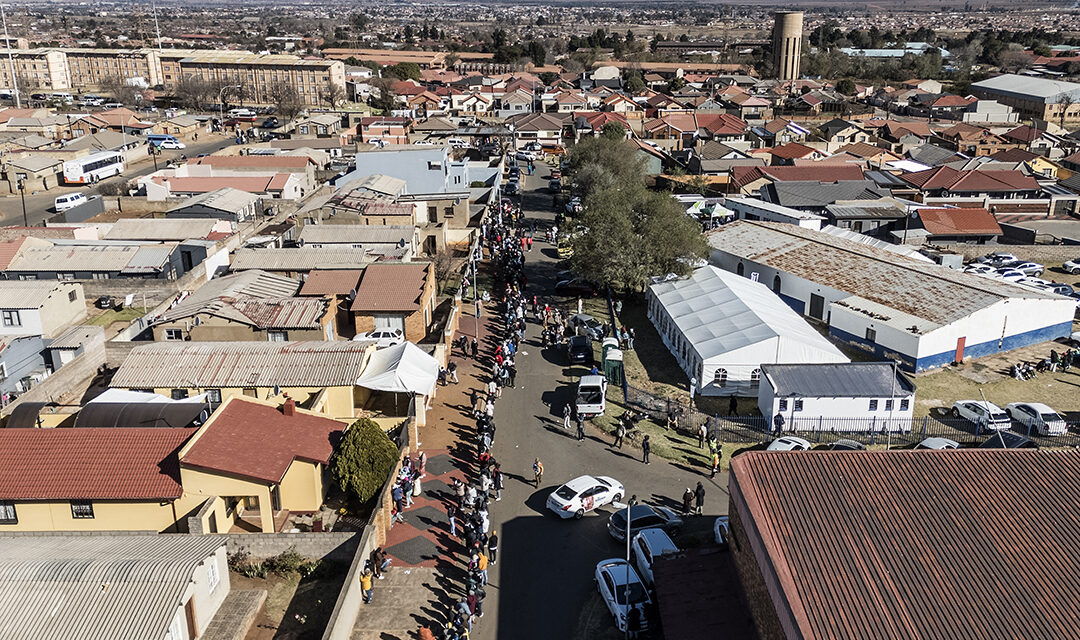
South Africa’s economy has hardly grown in more than a decade, and one in three people is unemployed. It begs the question: How are citizens surviving?
The true unemployment rate is substantially higher than the official 33% recorded by Statistics SA’s Quarterly Labour Force Survey, which tracks only those actively seeking work and unable to find it. The real figure is around 43%, which Stats SA defines as people who want work but have stopped searching because they believe no jobs are available.
A huge chunk of the cohort is young people. South Africa has about 21 million people aged 15 to 34, and among those available for and seeking work, nearly half (45.5%, according to the latest Stats SA Labour Force Survey) are unemployed.
How do they make ends meet? Where unemployment hits hardest, people cobble together survival through a patchwork of grants, family solidarity, informal hustle, borrowing, and constrained shared living.
For nearly one in four households (23.4%), social grants are the primary income source, according to Stats SA General Household Survey 2025. Sassa spent R267 billion on social grants in the 2024/2025 financial year, reaching 19.2 million beneficiaries. For the current year, the Sassa grant budget amounts to R292.8bn, roughly 11% of the national budget.
Often layered on top of that are earnings from informal work and, increasingly, gig work through digital platforms such as Uber, Bolt, Takealot, and Checkers Sixty60. Many young South Africans piece together incomes through ride-hailing, delivery driving, domestic work platforms and short-term contracts.
“The full picture includes remittances, irregular earnings, and pooled resources—a grandmother’s pension, an adult child’s informal side-hustle, and money sent by a cousin in Gauteng,” report Brendan Pearce and Bobby Berkowitz from FinMark Trust.
In terms of debt, an estimated 10 million South Africans are over-indebted, with 37% of formal credit borrowers facing repayment issues, according to a 2024 FinScope Consumer survey by FinMark Trust. Add those borrowing solely from informal sources, and the figure rises to about 12 million adults facing financial distress, the survey found.
Although this way of surviving might keep people sheltered and fed, it is a precarious way to exist. The unemployed don’t have medical aid and pensions, and there are high levels of hopelessness, depression, delayed independence, high crime vulnerability, substance abuse, and, not least, political anger among the unemployed youth, especially.
“It’s precarious not only for the individuals but also for the country because we have high levels of personal debt. Even among those formally employed, debt is a serious problem. If you combine the insecurity of gig work with trying to manage difficult debt situations, you’ve got a lot of stress, which leads to health problems and so on, that also places an extra burden on a narrowing tax base,” says Dr Ross Harvey, the head of research at Good Governance Africa.
The solutions are complex, but start with fixing the decaying national infrastructure. Chronic electricity supply problems have throttled manufacturing and small-business growth for years; rail and port bottlenecks raise costs and choke export-oriented job creation; and the long-term decline of industries like mining, tourism, and manufacturing needs to be redressed.
“We have to get the basics right,” Dr Harvey says.
Experts also agree on the need to make it easier for small businesses by reforming licensing requirements and introducing mechanisms such as digital one-stop platforms and risk-based tiering.
“Cutting red tape is crucial both to attract large-scale investments and also to enable informal traders and small township entrepreneurs to succeed,” said President Cyril Ramaphosa at the 2026 National Local Economic Development (LED) Summit.
At tertiary institutions, technical skills need to be built at scale by expanding workplace-based learning and apprenticeships, ideally co-designed with industry so that what’s taught matches what employers need, which increasingly includes strong digital skills.
The engineering, manufacturing, healthcare, nursing, and ICT sectors have all expressed the need to close the gap between what is taught and what the economy demands.
The informal sector and the gig economy lack this kind of consideration. Informal workers operate without contracts, labour protections, or access to conventional financial services, while gig workers are classified as “independent contractors”, which means they are responsible for their own expenses—fuel, maintenance and insurance—which eats into meagre earnings.
The African Commission on Human and Peoples’ Rights has noted that women bear a disproportionate burden here, recognising that “women in Africa remain the majority of the poor, the dispossessed, the landless, the unemployed, those working in the informal sector and those shouldering the burden of care”.
Some economists, like GG Alcock, an expert on South Africa’s informal economy, argue policy should integrate and support the survival economy rather than ignore it, through things like easier access to business banking, microloans and infrastructure (markets, storage, and transport) for informal traders.
“The businesses and entrepreneurs exist already. We have hundreds of thousands of them, but don’t recognise them. We do not need to start new businesses. We need to help them scale up,” he told the BizNews Conference in London in 2024, adding that the informal economy was worth R750 billion and one of the fastest-growing sectors in South Africa.
Thus, newer policy thinking treats the informal sector as a permanent and legitimate sector that deserves its own tailored regulatory architecture, rather than remaining a holding pen for people who failed to find formal employment.
It would mean informal and gig workers gain access to the unemployment insurance fund, healthcare, and pension through flexible contribution models that suit irregular income without having to register as formal businesses or become formal employees.
And with access to microloans, savings vehicles, digital payments, and fair platform terms, informal traders and gig workers could invest in their own operations, smooth income volatility, and build assets over time rather than living hand-to-mouth.
With youth unemployment so high, the informal and gig economies are realistically the primary absorbers of young workers for the foreseeable future.
However, without addressing the broader, structural constraints—infrastructure, over-regulation, failing state-owned enterprises, corruption, and so on—the informal sector and gig economy are even more constrained than the formal employment sector. Informal traders depend heavily on functioning municipal water and waste services, for example, and they are particularly vulnerable to crime.
Education and health are also key parts of getting the basic human capital in place for a thriving economy, notes Dr Harvey.
This requires reforms that will redress the learning deficit, which begins before Grade 1 (thus, greater support is needed for early childhood development and foundational literacy/numeracy), and strengthening primary healthcare clinics to combat TB, HIV, hypertension, and diabetes (TB is particularly devastating in employment terms because it strikes people in their prime working years).
Finally, if more people are able to move into productive employment—whether formal, informal, or gig—it will reduce fiscal pressure while expanding the tax base.
As Songezo Zibi, the chairperson of the standing committee on public accounts, said recently in Business Day, “We have compensated for the failure to grow the economy by placing more people on the dole to help them survive what would otherwise be crushing poverty and hunger.
“Therefore, our most important task is to grow the economy so that we can reduce debt service costs and transform millions of grant recipients into income taxpayers.”
It’s a long, windy road out of South Africa’s unemployment trap, but the government seems committed to walking it, if only in talk for now.
“Rapid inclusive growth remains our only durable path forward,” said Finance Minister Enoch Godongwana in the 2026 Budget Speech.

Helen Grange is a seasoned journalist and editor, with a career spanning over 40 years writing and editing for newspapers and magazines in South Africa. Her work appears primarily in Independent Online (IOL), The Citizen and Business Day newspapers, focusing on business trends, women’s empowerment, entrepreneurship and travel. Magazines she has written for include Noseweek, Acumen, Forbes Africa, Wits Business Journal and UJ Alumni magazine. Among NGOs she has written or edited for are Gender Links and INMED, a global humanitarian development organisation.