In a multipolar world, African agency rests on two pillars: reclaiming the continent’s physical space and resources, and liberating the African mindset from colonial legacies of subservience and post-colonial dependency.
This point was strongly highlighted by the panellists in the second of a series of dialogues being convened by Good Governance Africa (GGA) in partnership with the African Centre for the Study of the United States (ACSUS) at Wits University, ahead of the G20 Summit in November.
“Liberating your mind as an African, liberating your land, modernising your mind, modernising our land, are very crucial conditions as far as African agency is concerned,” said Dr Edward Kaweesi, politics lecturer at Makerere University in Uganda.
The dialogues, moderated by GGA’s CEO Lonwabo Patrick Kulati, are designed to explore how Africa can transition from being a policy taker to a policy shaper in a rapidly shifting global order. The initiative is building momentum toward the ‘Amplifying African Voices for Strategic Action (AFSA)’ conference being held on 25-27 November 2025, which follows the G20 Summit.
Modernisation through science, technology, and education was underscored as key to strengthening Africa’s global influence. Edward Sarpong, senior research coordinator at GGA’s Ghana office, also highlighted the urgency of strengthening Africa’s economic position in trade negotiations.
“Africa must improve its collective negotiation capacity to ensure its voice is heard internationally. We can no longer be satisfied with exporting raw materials like cocoa and gold without adding value. Each trade partner must leave behind critical technology and knowledge transfers so that our continent benefits equally, if not more, from these exchanges,” he said.
Sarpong added that Africa must establish its own standards rather than allow external powers to dictate the rules of trade. “We need to be deliberate. Africa must develop its own standards and institutions, send top experts to international platforms, and present written demands at negotiation tables. Only then can we leverage our resources into true bargaining power,” he said.
Indeed, our work at Good Governance Africa has insisted that multilateral trade is only mutually beneficial if African countries can ensure that they are not needlessly trapped in a model of exporting high-bulk, low-value commodities. In light of increasing demand – and strong likely demand over the next 50 years – for ‘critical’ minerals to power low-carbon economic transitions, this is a crucial moment for African countries to recalibrate what they want their futures to look like.
Dr Onalenna Selolwane, senior sociology lecturer at the University of Botswana, emphasised that African agency cannot be left to politicians, who are often compromised by external pressures. Instead, businesses, academics, NGOs, and civil society must forge direct links across the continent, building networks that speak with one voice to advance African sovereignty and protect resources.
“I think we are the only continent whose resources are adequate for us to power our manufacturing, leverage our population, and be as self-contained as the US is… We have what it takes…Let’s have a united policy, united laws that speak to how we can protect our natural resources and leverage our sovereignty,” said Dr Selolwane.
Forging collective action across countries with disparate national interests has proved challenging. Incumbent regimes benefit from being able to extract resource rents at the expense of building a broad tax base and modern economy. Doing so is seen as a threat to power, and entails higher transaction costs than merely depending on quick money from raw resource exports.
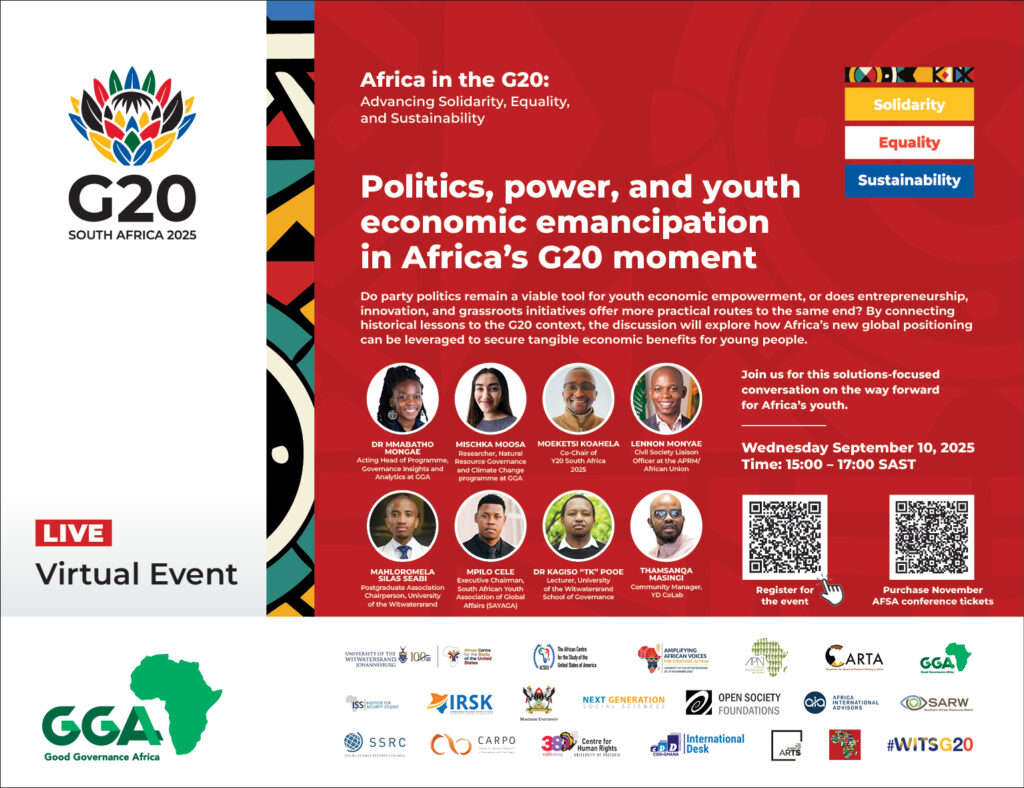
To register for our next dialogue, Politics, Power, and Youth Economic Emancipation in Africa’s G20 Moment, click the image below or scan the QR codes.

Helen Grange is a seasoned journalist and editor, with a career spanning over 40 years writing and editing for newspapers and magazines in South Africa. Her work appears primarily in Independent Online (IOL), The Citizen and Business Day newspapers, focusing on business trends, women’s empowerment, entrepreneurship and travel. Magazines she has written for include Noseweek, Acumen, Forbes Africa, Wits Business Journal and UJ Alumni magazine. Among NGOs she has written or edited for are Gender Links and INMED, a global humanitarian development organisation.