Africa Day, observed every 25 May, celebrates the continent’s unity and its democratic and institutional progress since the founding of the Organisation of African Unity in 1963. While much has been achieved, unity remains a fractious thing. This is largely because it depends on the integrity of the channels through which Africans receive information, understand public issues, and make political choices. In many parts of the continent, that channel is still radio.
The 1994 Rwandan genocide is a textbook example of how hate speech, carefully constructed and communicated via mass broadcast radio, can incite mass violence. Radio Télévision Libre des Mille Collines dehumanised Tutsis on air with incendiary language to ‘other’ them, identified individuals by name, directed killers to roadblocks, and narrated the slaughter in real time. The International Criminal Tribunal for Rwanda later convicted its founders of public incitement to commit genocide. About 800,000 people died in a hundred days.
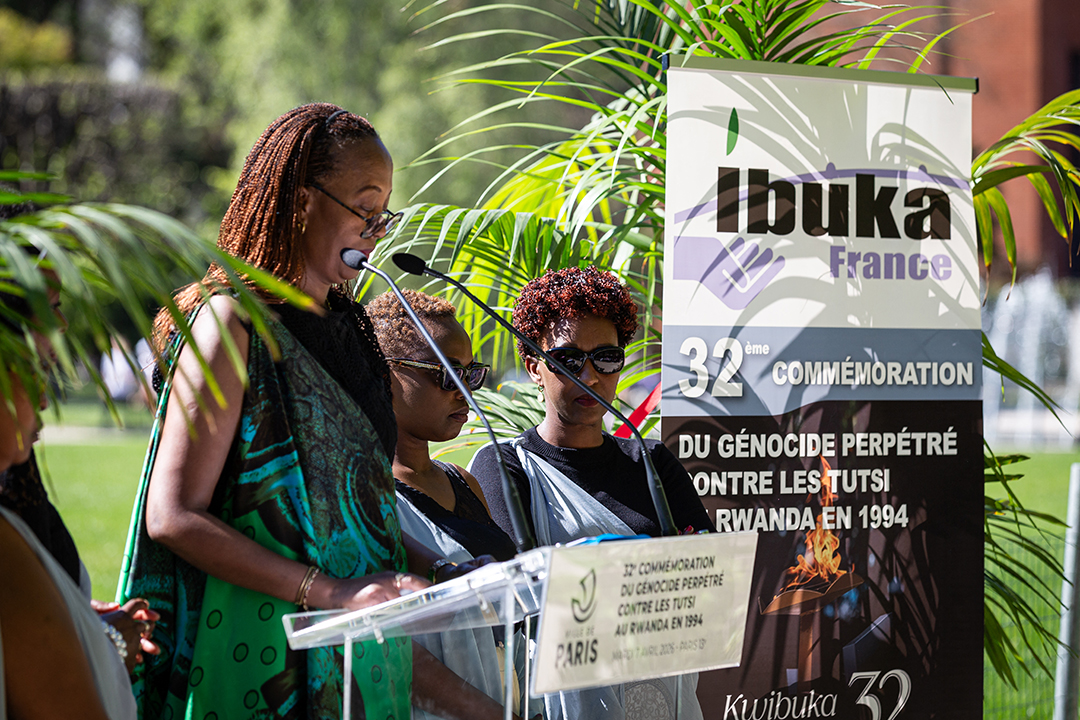
A survivor speaks during the 32nd commemoration ceremony of the 1994 genocide against the Tutsis in Rwanda, in the Garden of Remembrance in Parc de Choisy, in Paris, France, on April 7, 2026. (Photo by Telmo Pinto/NurPhoto)
Three decades later, radio remains the dominant medium for political information across Africa. Afrobarometer’s 2024/2025 survey of 38 African countries, drawing on nearly 51,000 interviews, finds that 59% of Africans get their news via radio every day or a few times a week, making it the continent’s most widely used news source, ahead of television at 53%, social media at 50%, and the internet at 38%.
Radio is the primary news source for women, rural residents, people living in poverty, and those without formal education. In Africa, radio is the infrastructure of political life, and almost nobody is building defences around it.
The gap nobody is closing
The global conversation about AI and disinformation has, understandably, concentrated on social media: fake accounts, coordinated posts, algorithmically amplified falsehoods on platforms where billions of people scroll. A paper published earlier this year in Science by 22 researchers, including experts in AI, political psychology, and democratic governance, warns of a coming era of “malicious AI swarms”: networks of autonomous AI agents capable of infiltrating communities, fabricating consensus, and adapting their messaging in real time.
These systems represent a leap beyond the clumsy botnets of the past. They maintain persistent identities, vary tone and content across agents, and operate without meaningful human oversight. The proposed defences in the paper, real-time monitoring of coordination patterns, statistical detection of inauthentic behaviour, and cryptographic provenance verification, are necessary, but they are also built almost entirely around text.
Recent disinformation detection often works by identifying anomalous patterns in how content spreads across text-based public platforms: suspicious similarities in timing, phrasing, and account behaviour that reveal coordination. These approaches are less useful in a voice note sent from one phone to another through WhatsApp’s end-to-end encryption, played aloud in a minibus, heard by fifty people, and forwarded to another hundred before any fact-checker has become aware it exists.
During Nigeria’s 2023 presidential election, false and manipulated political content moved rapidly across social media and encrypted messaging platforms, including WhatsApp. One viral audio deepfake falsely claimed that opposition candidate Atiku Abubakar and other PDP figures were discussing plans to rig the vote. Clips and voice notes attributed to political and public figures circulated through peer-to-peer networks that are less visible to platform moderation systems.
Ghana’s elections the following year showed the same problem. Manipulated audio clips circulated on WhatsApp and TikTok, falsely attributing remarks to John Mahama and Mahamudu Bawumia.
Researchers and local fact-checking organisations, including Dubawa, later reported that audio content was among the most difficult forms of disinformation to intercept, largely because it bypasses the public platforms where detection infrastructure is in place. This was before the current generation of voice cloning tools became widely accessible.
The sound of synthetic consensus
The Science paper notes that AI agent swarms are most effective at the peripheries of social networks, where early mobilisation and norm formation typically begin. Community radio call-in programmes and WhatsApp voice note chains are, by their nature, peripheral networks. They are local, trusted, and largely insulated from the centralised content moderation that operates on main social media platforms.
These peripheral points are where coordinated manipulation gains its earliest and deepest purchase, gradually shifting opinion before cascading outward. The architecture of Africa’s oral information network is, without anyone having planned it this way, perfectly suited to this kind of infiltration.
Today, generating a convincing synthetic voice requires a few seconds of source audio, a commercial platform (such as ElevenLabs, which makes this available to anyone with a subscription), and a basic prompt. The output can mimic regional accents, emotions, and ambient sound with sufficient fidelity to deceive unsuspecting listeners.
In a media ecosystem where community radio producers frequently receive audio clips from listeners via WhatsApp and sometimes broadcast them unverified during call-in programmes, such outputs may have serious consequences. A synthetic voice note designed to sound like a politician, government official, a community elder, or other prominent individuals does not need to fool a technical expert. It needs only to fool a producer on deadline at a small station in a rural African community; the radio does the rest.
Such vulnerability may be stronger in societies where political authority is communicated through voice: where a chief’s endorsement is heard rather than read, where a rumour of electoral violence spreads through a call-in programme, and where the credibility of a candidate is assessed by the grain of their voice.
Africa’s political cultures operate in different epistemic environments, with their own legitimacy structures that differ from text-based democratic traditions. Afrobarometer’s finding that radio remains the dominant form of news is partly a testament to this. Those structures are becoming more exposed and can be exploited in an era of large-scale AI-driven disinformation.
The researchers who wrote the abovementioned Science paper describe one mechanism of AI swarm influence that is particularly relevant here: the manufacture of synthetic consensus. Swarms can seed narratives across disparate communities, creating the illusion of majority agreement where none exists, amplifying this fiction through multiple fake voices until a manufactured position appears to be the organic view of community leaders and trusted figures.
When this operates through text on social media, a careful reader might at least notice the inconsistency. When it operates through audio, through a voice that sounds like a familiar politician, government official or other prominent individual, it targets a different and deeper form of trust. For many communities in Africa, radio is the institution that lends credibility to information. Synthetic consensus injected into that institution could corrupt a community.
Importantly, the Afrobarometer survey shows that among Africans with no formal education, radio is the primary news source, with 53% accessing it daily or several times a week. This is also the case for those living in poverty. These are also the communities least likely to have developed the learned scepticism that comes from years of navigating platform disinformation or from being trained in critical thinking.
Urban, educated Africans typically have some resistance to the worst of social media manipulation: they know an image can be edited or that a viral clip might be stripped of context. Their rural counterparts, who have trusted community radio for decades, have not had the same training ground. The communities whose political participation is most vital and most fragile are the ones a synthetic voice would find easiest to reach.
Governance fatigue and foreign hands
This gap between where manipulation is most potent and where defences are being built has a notable class dimension. International AI governance frameworks, election observer missions, and national or regional AI strategies tend to focus on social media and text-based platforms. These are channels the digitally-connected use, while radio is the medium that everyone else uses. Protecting the former while leaving the latter unguarded can come with serious vulnerabilities.
For example, in countries where digital news media use is below a quarter of the population, according to Afrobarometer – Madagascar at 13%, Chad, Malawi, and Uganda each at 24% – radio is dominant, and in many communities, it is the only mass medium. Any AI governance or disinformation framework that does not explicitly address audio authenticity in these contexts is a framework designed for the wrong population.
These are also, with variation, contexts that have struggled to democratise, and healthy scepticism toward information is itself a capacity that populations build through the democratisation process. Without it, communities may be more susceptible not only to synthetic consensus but also to populist politicians and military actors who exploit instability. Madagascar, with a 13% digital reach and a history of recurring political crises, illustrates how these vulnerabilities may compound.
The Sahel coup belt – Guinea (2021), Mali (2021), Burkina Faso (2022), and Niger (2023) – shows where these vulnerabilities lead when left unaddressed. The disinformation campaigns that preceded and accompanied those transitions have been documented by the Africa Center for Strategic Studies.
Russia-aligned networks linked to the Wagner ecosystem and now operating under Africa Corps, have used coordinated information campaigns to delegitimise elected governments, discredit Western partners, and build public support for military intervention. Its media wing, African Initiative, maintains local offices in Bamako and Ouagadougou, in countries where community radio remains the dominant news source, which may shape public opinion at the community level.
Foreign actors competing for access to Africa’s critical minerals may also have incentives to see sympathetic administrations in power. The DRC holds about 70% of the world’s cobalt; Zimbabwe and Mali hold significant lithium deposits; in Burkina Faso, gold has become entangled with political survival, with recent analysis suggesting it is suspected of helping finance Russia’s war in Ukraine and underwriting security deals with Russian contractors.
China has invested around $4.5 billion in lithium projects in Zimbabwe, the DRC, Mali, and Namibia. Russia’s documented influence operations across Africa, estimated to cost around $750,000 per month, are remarkably cheap relative to the strategic access they seek to secure. Voice manipulation makes such operations faster, cheaper, and harder to trace, allowing outside actors to more easily shape the politics around valuable assets.
It costs very little to generate a synthetic voice and send it into the voice-based networks described in this article. What costs money is the defence: training journalists, maintaining detection systems, and building response teams that can work across African languages. The incentive is obvious for a foreign actor seeking influence in a resource-rich country. The damage to the targeted society may only become visible later, through mistrust, contested results, and rising political risk and instability.
This is why audio disinformation is also an economic risk. Political instability raises the cost of capital, discourages long-term investment, disrupts supply chains, and makes contracts harder to enforce. UN Trade and Development has warned that political instability and fragmented regulatory frameworks contribute to Africa’s high-risk investment environment. In resource-rich countries, a poisoned information space can quickly become a poisoned investment climate.
The same applies to election monitoring. Some international and African Union observer missions have, in recent cycles, developed some capacity for tracking online disinformation in text form. None has yet established a systematic capacity to monitor AI-generated audio circulating through encrypted channels, where the next wave of electoral manipulation is likely to occur.
What response requires
A serious response would start with acknowledging audio as a key form of disinformation in Africa. It would also require investment in audio deepfake detection systems designed for African languages and acoustic environments, rather than just English, French, and Mandarin, which dominate existing research literature. Voice cloning models trained on limited African-language data are currently harder to detect using standard tools, because those tools were not built with those languages in mind.
Existing detection tools are also not yet reliable enough to do this work on their own. Dubawa reported that during Ghana’s 2024 election, tools such as Hive Moderation, Resemble AI, and Deepware produced inconsistent results, forcing fact-checkers to compare viral clips manually against previous interviews, speech patterns, intonation, accent, and context.
Organisations that perform essential work in the text-based verification space would need dedicated audio units collaborating with radio networks. National electoral commissions across the continent would also need to extend their anti-disinformation mandates to audio, including through partnerships with organisations capable of monitoring encrypted messaging ecosystems.
There is already a foundation to build on. Organisations such as Dubawa, the Centre for Journalism Innovation and Development, the Centre for Democracy and Development, and Africa Check have developed some verification capacity. What is missing is scale, stable funding and a formal bridge to the radio ecosystem.
Community radio stations themselves, the last editorial gatekeepers before a voice reaches thousands of listeners, cannot be left to figure this out alone. Basic audio verification training, analogous to the image authentication training that newsrooms received a decade ago as doctored photographs became common, should be a priority for media organisations and other stakeholders. That training should go beyond giving journalists an AI detector to include simple audio forensics, source tracing, comparison with older recordings, and checks for coordinated circulation patterns.
The overall response will not be easy to build. This is especially true given that encrypted messaging platforms are architecturally resistant to systematic monitoring. Small stations also do not often have a budget for sophisticated technical infrastructure. And the Science paper is correct that defence is always a reactive arms race: the incentive structures of the commercial AI industry do not naturally favour closing the vulnerabilities they have opened.
Africa Day reminds us that Africa’s unity and democratic future also depend on protecting channels through which citizens receive information. But there is particular negligence in building defences around the channels mostly used by wealthy, educated, urban Africans, while leaving unprotected the channels that reach the majority of the continent’s citizens.
Thirty years ago, a radio station became a weapon that helped organise and contribute to the killing of about 800,000 people. The tools available now are even more sophisticated and easier to weaponise. Africa’s oral democracy deserves better than to discover that the hard way.
This article first appeared in Business Day.

Nnaemeka served as a Senior Data Analyst at Good Governance Africa. He completed his PhD in Applied Data Science at the University of Johannesburg, South Africa, supported by South Africa’s Department of Science, Technology and Innovation. His research applies data science and computational methods to questions of governance, social bias, political attitudes, human development, and disinformation. His work has been published in journals including EPJ Data Science, Journal of Computational Social Science, Social Science Computer Review, Political Psychology, and Politeia. He has also worked as a Data Consultant at DataEQ Consulting and has teaching experience at the University of the Witwatersrand, both in South Africa.