The ongoing conflict involving the United States, Israel, and Iran has triggered fresh volatility in global energy markets. With the closure of the Strait of Hormuz, a vital artery for global crude shipments, Brent crude prices have risen significantly above Nigeria’s 2026 budget benchmark of $64.85 per barrel. This development raises two competing narratives: the promise of higher fiscal revenues and the threat of renewed domestic price instability.
Historically, geopolitical crises in the Middle East have triggered sharp but uneven economic effects in Nigeria. A clear example was the 1990–1991 Gulf War, when Iraq’s invasion of Kuwait sent global oil prices upward. Nigeria experienced a temporary surge in oil earnings within months, but the gains were short-lived and largely absorbed by fiscal expansion rather than long-term stabilisation. Also, the 2003 Iraq War created a pre-war oil price spike (traders priced higher in expectation of war) that increased Nigeria’s export earnings, but persistent structural issues – pipeline vandalism, crude theft, operational inefficiencies, and opaque remittance structures – continued to strain public finances.
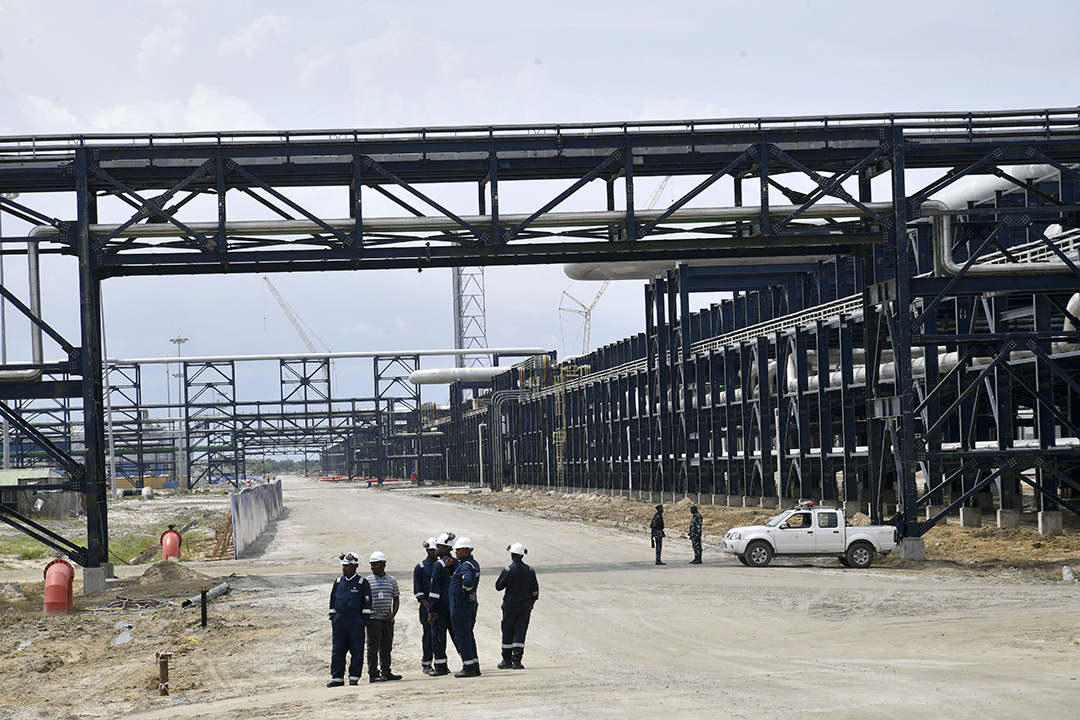
Workers stand at a section of the Dangote Petroleum Refinery Petrochemicals in Lagos. Dangote Petroleum Refinery and Petrochemicals is the largest single-train refinery in the world, with a 650,000-barrel-per-day refining capacity. (Photo by PIUS UTOMI EKPEI / AFP)
With the current conflict, Nigeria stands to earn more per barrel than assumed in its budget framework, particularly with the coming on stream of the Dangote Refinery that has boosted domestic production of petrol, diesel, and other crude oil derivatives such as petrochemicals, all of which were previously imported. The current disruption to the global energy market should translate into stronger foreign exchange inflows, improved external reserves and higher allocations from the Federation Account Allocation Committee (FAAC) to federal, state and local governments.
Crude oil remains Nigeria’s dominant export commodity, accounting for roughly 80% of total export earnings and about half of government revenue in recent years. Consequently, fluctuations in global oil prices continue to have significant implications for the country’s fiscal space, external reserves, and exchange rate stability.
While efforts to diversify the economy have gained traction, the gap between oil and other sectors remains substantial. Agriculture, which employs a large share of Nigeria’s workforce and contributes roughly 23-25% of GDP, remains the next most significant sector of the real economy.
However, unlike oil, agriculture generates relatively limited foreign exchange earnings. Nigeria’s crude production has, however, struggled over the years to consistently meet potential output levels due to the structural issues mentioned. While Nigeria was once capable of producing over two million barrels per day (bpd) and has an official OPEC quota of about 1.8 million bpd, actual output has frequently fallen short of this level in recent years. Production dropped to as low as around 1.0 to 1.2 million bpd between 2022 and 2023, largely due to widespread oil theft and pipeline sabotage.
This concern was reinforced in 2025 by findings from Good Governance Africa’s (GGA-Nigeria) survey titled “Investors’ Perceptions of Nigeria’s Regulatory and Policy Reforms in the Oil and Gas Sector”. Our survey delivered a unified and urgent message to the Nigerian government and its regulators that while respondents expressed optimism about recent reforms, particularly the enactment of the Petroleum Industry Act, they also pointed to weak regulatory capacity, bureaucratic inefficiencies and implementation delays in the oil sector as persistent constraints to greater output and investment attraction.
The survey highlighted a crucial lesson for Nigeria amid current geopolitical tensions. Even if rising crude prices driven by the US–Israel–Iran war boost export earnings, structural weaknesses in daily production capacity, revenue capture, regulatory coordination, and institutional performance could significantly limit the fiscal benefits. In other words, higher oil prices alone are not enough. Without transparent crude accounting, effective oversight, and consistent policy implementation, Nigeria risks repeating a familiar pattern where external windfalls fail to deliver lasting macroeconomic stability or meaningful improvements in public finances.
Refining equation
Nigeria’s downstream sector is undergoing a significant shift with the Dangote Refinery ramping up operations. President Bola Tinubu’s administration is prioritising domestic crude allocation to local refineries, reducing reliance on imported crude. This move conserves foreign exchange, boosts local value addition, and mitigates global supply risks. But domestic fuel pricing still references international market dynamics, and the Dangote Refinery still requires the importation of a heavier crude variant that Nigeria does not produce to blend into its refining input. Hence, when global crude prices rise due to the war involving the United States, Israel and Iran, the cost of crude input rises.
As global crude prices rise and war risk insurance premiums increase, refiners and marketers adjust ex-depot prices accordingly. Consequently, while Nigeria may earn more from crude exports, citizens simultaneously face higher pump prices, intensifying transport costs, food distribution expenses and overall inflationary pressure. In fact, Dangote Refinery has recently announced an increase in the price of petrol.
That is Nigeria’s oil paradox. The country may sell crude at higher prices, and government revenues rise. But because petrol, diesel and transport costs increase almost immediately, households and businesses feel pressure. Transport fares go up. Food prices climb. Manufacturers raise product prices to cover diesel and logistics costs. What begins as a geopolitical oil shock becomes a trigger for domestic inflation. This explains why rising oil prices can improve national fiscal balances while worsening household welfare.
Turning crisis into reform momentum
The central issue is not the price of oil but the quality of governance. Without transparent tracking of crude volumes, pricing formulas and remittances into the Federation Account, higher oil prices risk being absorbed into inefficiencies rather than strengthening fiscal gains. To convert the current geopolitical turbulence into a foundation for long-term stability, Nigeria must institutionalise reforms rather than rely on temporary price advantages.
First, oil revenue windfalls should be channelled into fiscal buffers and debt reduction, rather than expanded recurrent spending. Second, improved digital tracking of crude production and exports can reduce leakages and enhance revenue capture. Third, targeted social safety mechanisms should cushion vulnerable households against fuel-driven inflation.
If not properly managed, what appears to be a fiscal gain at the federal level can quickly translate into a cost-of-living squeeze at the household level. In such an environment, public confidence in reform efforts may weaken unless there is clear evidence that additional revenues are being captured effectively and deployed prudently.
The lesson from the crisis between the US, Israel and Iran is not simply about oil prices. It is about institutional readiness. Nigeria’s macroeconomic resilience depends less on the direction of Brent crude and more on the strength of its governance systems. If properly managed, higher oil prices can reinforce fiscal stability and accelerate reform. If mismanaged, they risk deepening inflationary pressures while perpetuating the structural weaknesses that have long constrained Nigeria’s development.

Oladiran (Ola) Bello obtained both his MPhil and PhD degrees in International Relations from the University of Cambridge and also holds a First Class BSc degree from the Obafemi Awolowo University, Ile-Ife. He has worked for organisations including the United Nations (New York) and Management Systems International (Washington DC), Merchant International Group (London) and Arthur Andersen (later KPMG). Dr Ola Bello has more than 10 years of experience in research and policy advisory, including on governance and extractive sector reform; sustainable development; and international development cooperation (including in EU-Africa relations). He spent three years with FRIDE (Spain) managing a donor-funded programme on the EU’s role in managing fragility and resource governance in select African countries. In 2012-2015, he was Head, Governance of Africa’s Resource Programme (GARP) at the South African Institute of International Affairs (SAIIA) and also functioned as head of SAIIA’s Cape Town office. Ola is spearheading GGA's technical support to Nigerian reform, including delivering ethics training for senior Nigerian judicial officers and change-makers (2017-2019). He's also working to expand GGA's role as in-country resource centre for multilateral consultative missions to Nigeria's ministries and parastatals. These missions include the UNECA/AU mineral sector governance team.

Adejumo Kabir Adeniyi is a senior researcher at Good Governance Africa-Nigeria. He is an expert with many years of experience in community development work and governance accountability sector. Before joining GGA, Adejumo worked at Premium Times and HumAngle Media, two of Nigeria’s biggest newspapers specialising on conflict and accountability reporting. His work has featured on esteemed local and international platforms, including Zam magazine, El Pais, IJNet, Premium Times, HumAngle Media and TheCable among others. He is a 2019 recipient of the Diamond Awards for Media Excellence, a 2020 recipient of the Thomson Foundation Young Journalist Award in the United Kingdom, and a 2021 recipient of NAREP Oil and Gas Fellowship.