Nigeria’s worsening security crisis is forcing federal and state authorities to experiment with solutions that would once have appeared unlikely. One of the most striking is the recruitment and deployment of former Boko Haram members from the Northeast to support efforts against bandits and jihadist groups in Northwest and Northcentral Nigeria.
Interviews with former Boko Haram members involved in these deployments indicate that some have been deployed to Niger and Zamfara states, while others have been sent to Kaduna, Kebbi, Sokoto, Katsina, and the Federal Capital Territory. According to those interviewed, the State Security Services (SSS), Nigeria’s domestic intelligence agency, has played an important role in recruiting and deploying these former Boko Haram members.
“SSS spoke to our community leaders,” a former Jama’atu Ahlis Sunna Lidda’awati wal-Jihad (JAS) fighter deployed to Zamfara explained. “They said we should come here to help our fellow Muslims who were facing insecurity.” Others currently deployed in Katsina, Kebbi and Niger states, as well as those previously deployed to Sokoto, gave Good Governance Africa similar accounts: they were initially contacted through their community leaders before the SSS took over the recruitment process.
Though this has reportedly been taking place for more than three years, the arrangement remains largely outside public discussion, and its precise command, vetting and accountability structures are unclear. Yet it points to an important development in Nigeria’s response to insecurity: the state is seeking to convert some of the experience accumulated during more than 15 years of fighting Boko Haram into an asset for confronting emerging threats elsewhere.
This is occurring at a particularly difficult moment. Nigerian security forces are overstretched across multiple theatres. The military continues to confront the Islamic State West Africa Province (ISWAP) and JAS in the Northeast while simultaneously participating in operations against bandits and jihadists across Northcentral and Northwest Nigeria. The Southwest is also showing increasing vulnerability to threats emanating from these regions.
“It is impossible for us [security forces] to deploy to every community in the country. It is unimaginable that any security agency has that resource to do it,” SSS Director-General Oluwatosin Ajayi, stated in 2025, while encouraging community leaders to reach out to the Service for “approval and guidance” on arming their communities to serve as the “first line of defence” against non-state armed actors.
State and local governments confronted with persistent attacks, kidnappings and rural displacement have consequently sought additional manpower through vigilantes, community protection forces and other auxiliary arrangements. The recruitment of former Boko Haram members should be understood partly within the broader context of security necessity.
But these former insurgents bring something that ordinary recruits generally do not: first-hand experience of jihadist warfare.
While this article focuses on former Boko Haram members – individuals who once fought against the state – they are not the only ones recruited for deployment to the Northwest and Northcentral. Rather, they form part of a broader contingent that includes other community-based security actors, such as members of the Civilian Joint Task Force (CJTF), hunters and vigilantes. Most of those recruited are drawn from Borno, Yobe and Adamawa states, with others coming from Gombe and Bauchi.
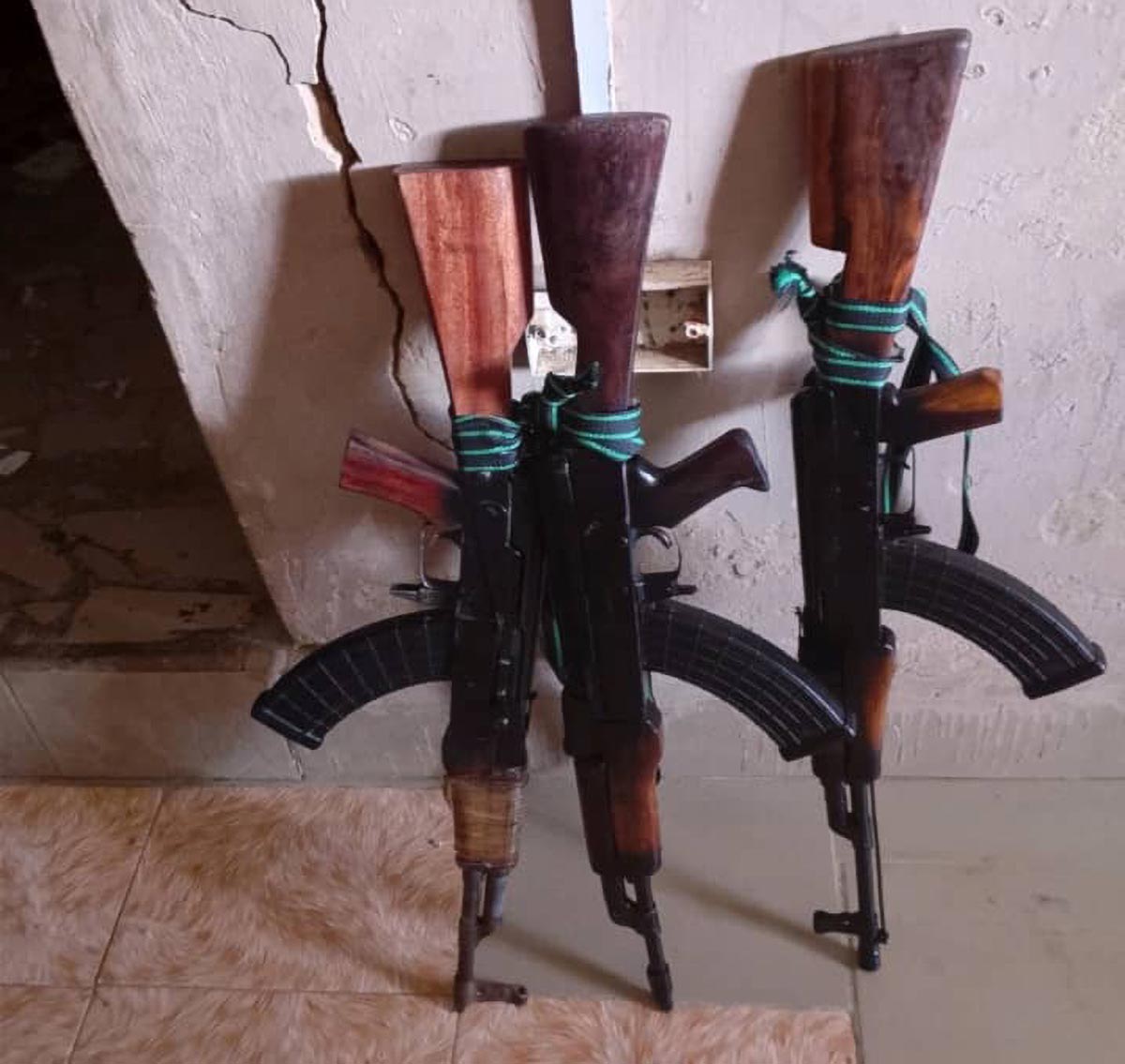
Rifles issued to former Boko Haram members fighting insecurity in Northwest and Northcentral Nigeria.
An unusual reservoir of experience
Former Boko Haram fighters who spent years operating in an insurgency may understand ambushes, reconnaissance, concealment, camp organisation, insurgent logistics and small-unit movement. Depending on their former roles, they may also have knowledge of improvised explosive devices, intelligence gathering, surveillance, recruitment and the ways armed organisations interact with communities.
This is particularly relevant because the threat in Northwest and Northcentral Nigeria is itself changing.
Banditry remains the dominant form of insecurity across much of the region, especially in the Northwest, but jihadist organisations are becoming increasingly significant. In 2026, the Islamic State Sahel Province (ISSP) officially claimed attacks in Kebbi and Sokoto states, its first publicly claimed operations in Nigeria in more than six years.
The wider Benin-Niger-Nigeria borderlands have also become important to both ISSP and the al-Qaeda-affiliated Jama’at Nusrat al-Islam wal-Muslimin (JNIM). This potentially increases the operational relevance of the experience held by some former Boko Haram members.
All former fighters interviewed in the regions argued that the threat posed by Boko Haram in the Northeast was tactically more complex than the challenge they had encountered from bandits.
“Boko Haram uses Improvised Explosive Devices, suicide attacks, drones, gun trucks, etc. Boko Haram fighters are not afraid to die. Bandits are not like that. They don’t have the experience and equipment that Boko Haram has. They also don’t want to die, which is why they retreat when faced with more firepower.”
This assessment should not be interpreted as suggesting that bandits are unsophisticated. Many possess military-grade weapons, including anti-aircraft guns, extensive intelligence networks and detailed knowledge of local terrain, while some have recently begun using explosive devices. The former Boko Haram members’ accounts nevertheless illustrate the unusual operational background they bring to their new roles.
Local response against a glocal problem?
The experiment also raises a wider policy question at a time when private and foreign military forces have assumed increasing prominence in parts of Africa, especially in countries confronting jihadist threats.
Mali, Burkina Faso and Niger – the three members of the Alliance of Sahel States (AES) – face many of the same jihadist adversaries now threatening Nigeria. JNIM and ISSP, two of the principal armed jihadist groups operating across the Sahel, have also extended their activities into Nigeria.
Yet the strategies being adopted differ significantly.
The AES countries have relied extensively on the Russian state-backed Africa Corps, which succeeded the Wagner Group’s operations in the region. The appeal is understandable. Foreign forces can provide specialist skills, equipment and experienced personnel rapidly.
But they also come with considerable drawbacks.
Media and civil society organisations have repeatedly documented allegations of human rights violations involving Africa Corps personnel, especially in Mali. In August 2026, Human Rights Watch reported allegations that Africa Corps personnel were involved in unlawful arrests, arbitrary detention, and the extrajudicial killings of civilians, including women and children, as well as the burning of civilian property. These are not merely human rights concerns. Civilian abuses can also undermine counterinsurgency efforts by generating grievances, weakening intelligence cooperation and strengthening jihadist recruitment narratives.
External forces also face the disadvantage of operating in environments with which they may have limited familiarity. Language, social relationships, cattle routes, informal economies, local grievances and community allegiances often matter as much in counterinsurgency as weapons and battlefield experience.
The employment of foreign military forces or contractors does not guarantee success, as developments in the Sahel demonstrate. Despite the presence of Russia’s Africa Corps, Mali has continued to face serious threats from jihadist and separatist groups. In April 2026, coordinated attacks by JNIM and the Tuareg-led Azawad Liberation Front (FLA) resulted in the capture of Kidal, a strategically important northern city. Africa Corps personnel, deployed to protect the city, later withdrew after negotiating an exit with the groups.
The same offensive highlighted vulnerabilities within Mali’s security establishment, with Defence Minister Sadio Camara reportedly killed in an attack on his residence in Kati, near Bamako, while other military and strategic locations across the country were targeted.
Nigeria’s approach potentially offers something different. Instead of importing knowledge of irregular warfare, it is attempting to repurpose knowledge already accumulated within the country. This raises a potentially important question for other countries confronting similar security challenges.
The Nigerian approach is also considerably cheaper than employing foreign military contractors, whose continued involvement may depend on contractual and financial considerations rather than a long-term commitment to the country’s security. Africa Corps personnel in Mali reportedly earn approximately US$3,000 per month. Nigeria also reportedly paid similar salaries to South African-led contractors from Specialized Tasks, Training, Equipment and Protection (STTEP), who were engaged to support the fight against Boko Haram in 2015.
By contrast, former Boko Haram members deployed to Northwest and Northcentral Nigeria receive a monthly salary of N70,000 (approximately US$53), according to those interviewed and payment details seen by Good Governance Africa. However, their participation is not necessarily motivated by income alone. For some, it also offers an opportunity to demonstrate their disengagement from Boko Haram, seek to make amends for their past involvement, and build a new life through service to communities threatened by armed violence.
Nigeria’s persistent and deteriorating security situation has led to calls, including from a lawmaker, for the employment of private military contractors (PMCs). During the #EndBadGovernance protests, Russian flags were openly displayed by protesters in Kano, Northwest Nigeria, with some protesters calling for Russia’s help. Given Nigeria’s close cultural and familial ties with the Republic of Niger, propaganda surrounding Russia’s involvement in the Sahel can also circulate in Northwest Nigeria. Northern Nigerian influencers have reportedly been targeted to support pro-Russia narratives in the Sahel.
The Southwest is also not immune to narratives that glorify military juntas in the Sahel and promote foreign military intervention.
A foreign contractor may have experience fighting jihadists, but a former Boko Haram member may have experienced the conflict from inside a jihadist organisation.
A person who spent years inside Boko Haram may therefore possess knowledge extending beyond combat skills to the organisation’s tactics, structures, motivations and ways of operating. That represents a fundamentally different form of operational knowledge.
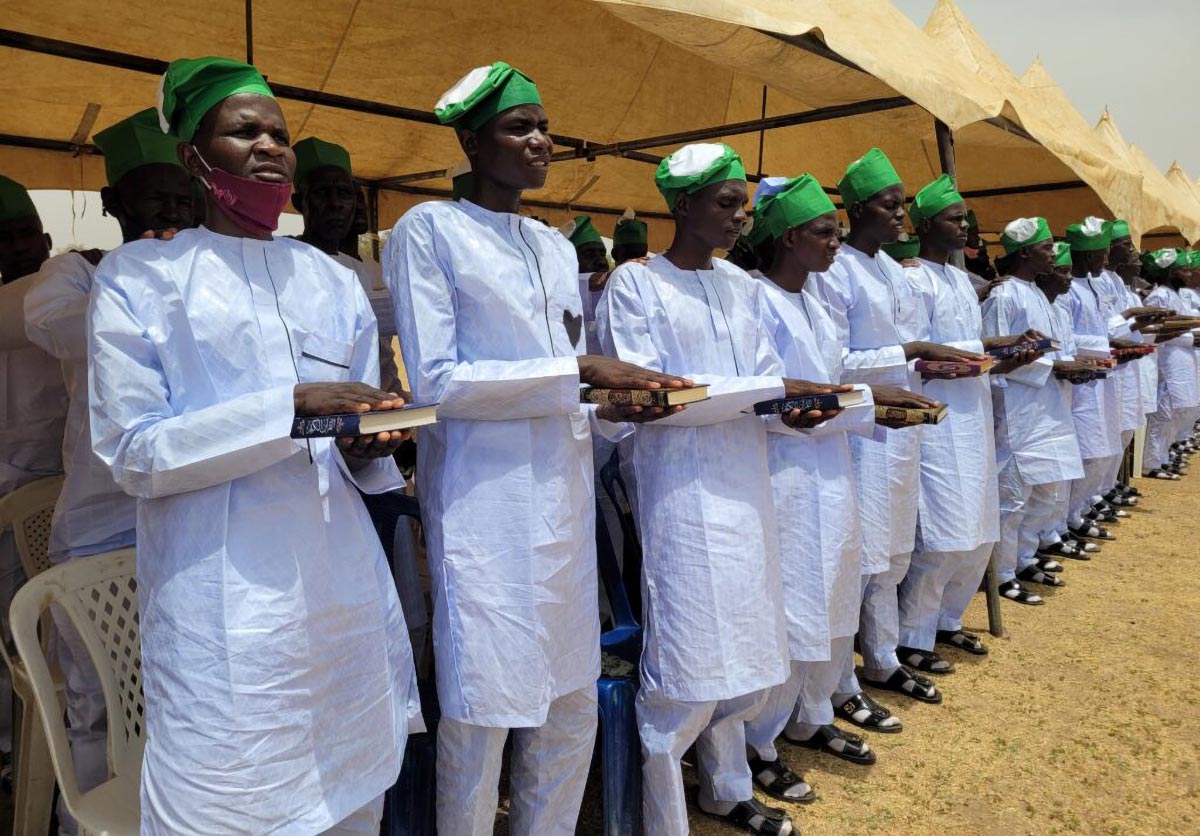
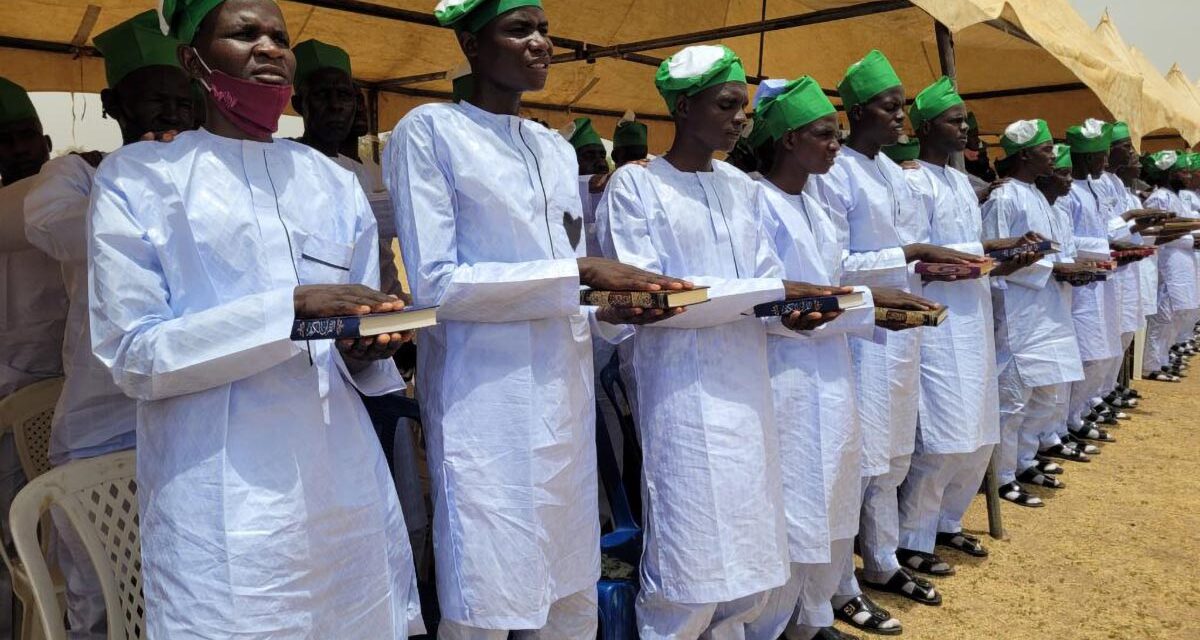
Rehabilitated former Boko Haram fighters. Some are deployed to Northwest and Northcentral Nigeria. Photo by Spye News.
Promising, but dangerous if poorly managed
So far, respondents and communities interviewed reported no major negative incidents involving the deployed personnel. This may partly explain why their involvement has not generated widespread public concern.
The men interviewed described developing strong relationships with host communities. In many locations, they are among the first responders when bandits or jihadists attack. They also escort farmers to and from their farms and provide security during social events, including weddings and religious and cultural festivals. Community members said their presence has a deterrent effect on bandits, who they say regard them as tough opponents because of their willingness to stand their ground during attacks.
To prevent prolonged deployment in one location from fostering complacency or excessive familiarity with the local environment, personnel are rotated both within and between states. All those interviewed said they had previously served in at least two other locations before their current deployments, while some were awaiting further rotation at the time of the interviews.
None of this means Nigeria should begin recruiting former Boko Haram members on a large scale. The approach carries substantial risks.
Former insurgents could return to extremist organisations. They could infiltrate security structures, divert weapons, abuse civilians or use their new positions to settle personal disputes, including grievances against the state.
Some of these risks have already materialised in the Northeast, particularly in Borno State, where some former fighters have returned or threatened to return to insurgent groups amid shortcomings in the management of their disengagement and reintegration. Some former fighters recruited and armed to support security forces against Boko Haram have reportedly returned to insurgent groups with weapons issued to them.
This may help to explain why the SSS reportedly maintains close oversight over these recruits in the Northwest and Northcentral.
Each unit has a senior member known as a “discipline master,” responsible for maintaining discipline within the group. The discipline masters’ mandates reportedly extend to the spouses and families of the deployed men, including commanders. Sanctions for infractions range from reprimands and detention to outright dismissal and return to the individual’s state of origin.
Turning experience of conflict into a security resource
The deployment of former Boko Haram members to Northwest and Northcentral Nigeria should therefore neither be romanticised nor dismissed.
It is best understood as an experiment born of necessity, but one that raises significant questions about oversight, accountability and long-term security governance.
Nigeria is in its 17th year of accumulating hard-won experience in fighting jihadism. Some of that knowledge resides within the military and intelligence services. But some also resides among those who once fought against the state.
Carefully screened former insurgents could potentially contribute manpower, local familiarity and insights into irregular warfare while gaining employment and an opportunity to build lives outside jihadist organisations. But realising these potential benefits depends on credible vetting, clear command structures, effective oversight and mechanisms to ensure accountability for misconduct.
If the model proves effective, it could offer an important lesson for Nigeria and the wider Sahel: countries facing insurgency do not always need to choose between overstretched national forces and expensive foreign military assistance.
There may be a third option – finding ways to transform knowledge produced by conflict into a resource for ending it.
The objective should not be to replace professional soldiers and police officers with former Boko Haram fighters. Nor should participation in security operations become a substitute for accountability.
Rather, Nigeria could examine whether carefully selected former combatants whose disengagement is credible can be integrated into tightly regulated auxiliary structures where their knowledge has genuine operational value, while ensuring that such arrangements remain subject to appropriate state oversight, human rights safeguards and public accountability.
The former fighters interviewed for this article have already undergone an extraordinary trajectory: from Boko Haram in the Northeast to fighting armed groups hundreds of kilometres away in Northwest and Northcentral Nigeria. Some of the men who made that journey with them have been killed in the process.
Their experience raises an uncomfortable but increasingly relevant question.
Can people who once contributed to Nigeria’s insecurity become part of the solution to it?
Nigeria’s emerging experience suggests that they potentially can – but only where reintegration into security roles is accompanied by rigorous vetting, effective oversight, clear accountability, and safeguards for the communities they are intended to protect.

Malik Samuel is a senior researcher at Good Governance Africa-Nigeria. Before joining GGA, he was a researcher with the Institute for Security Studies, specialising in the Boko Haram conflict in the Lake Chad Basin Region. Malik also worked as a conflict researcher with Amnesty International Nigeria. He was also a Médecins Sans Frontières/Doctors Without Borders field communications manager in Northeast Nigeria. Before that, he was an investigative journalist at the Abuja-based International Centre for Investigative Reporting. Malik holds a Master's degree in Conflict, Peace, and Security from the Universitat Oberta de Catalunya and the United Nations Institute for Training and Research (UNITAR).