Citizen engagement is the process by which governments involve the community in public issues through democratic discussions. As such, citizen engagement is at the centre of democratic governance. Through voting, protest action, attending community meetings, and contacting local councillors, citizens can enhance effectiveness, accountability, and transparency. But what are the consequences when citizen participation is disregarded, and how is civic engagement evolving in South Africa? What insight do trends in civic engagement give us on the type of democracy emerging in South Africa?

Alexandra township residents gesture and chant slogans as they clash with the Johannesburg Metro Police on April 3, 2019 in Johannesburg, South Africa during a total shutdown of the township due to protests against the lack of service delivery or necessities such as access to water and electricity, housing difficulties and lack of public road maintenance. Photo by STRINGER / AFP
Democratic participation is meant to influence decision-making processes. However, its observable impact on local governance appears limited. One contributing factor may be how the government engages with citizens. For example, planning and budget documents presented by the local government are often lengthy, use technical terminology, and are released shortly before formal public consultations. As a result, the timeframe available for citizens to read, interpret, and respond to them is constrained, which may restrict the potential for informed input into planning, budgeting, and service delivery.
From a data perspective, there is an overall decline in civic engagement. But what does this suggest, and more importantly, what modes of civic engagement are declining, and what does this tell us about political behaviour in South Africa?
What does the data tell us?
It is important to note that civic engagement encompasses multiple political and civic activities. The type of civic engagement that most South Africans engage in may give insight into how South Africans are choosing to engage with the state.
The 2025 Afrobarometer report identifies 10 indicators for civic participation: voted in the last national election, feel close to a political party, discuss politics occasionally/frequently, attended a community meeting, joined others to raise an issue, contacted a traditional leader, contacted a local councillor, contacted a political party official, contacted a member of parliament, and participated in protest/demonstration.
Discussions on civic participation often centre on elections and protest action. Elections are often recognised as the bridge between citizens and politicians, and a continuous decline in voter turnout suggests that there is a disconnect between citizens and politicians. Based on the continued decline in voter turnout, we could deduce that there is growing apathy in South Africa. However, it is important to consider other modes of participation.
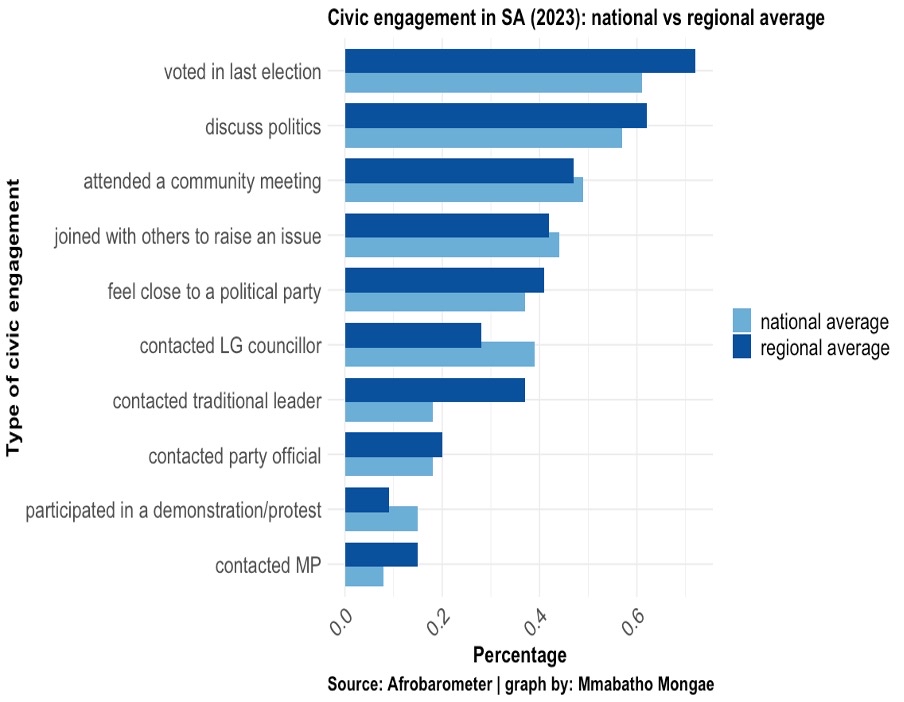
The above graph compares civic engagement in South Africa to the regional averages. The figure indicates that national responses for attending a community meeting, joining others to raise an issue, contacting a local government councillor, and participating in a demonstration or protest are higher than the regional averages. This indicates that in South Africa, participation is deeply rooted in movement-based, consultative, and mobilised forms of civic engagement.
This trend is rooted in the country’s history of struggle-based activism, where civic engagement was often collective, issue-based, organised around mobilisation – in essence, institutional participation did not inform civic engagement.
Cumulatively, targeting councillors, community meetings, and participating in demonstrations shows that everyday governance is what informs how ordinary citizens perceive the effectiveness of a political system and is what is used to assess democratic governance.
Responses also indicate that contacting a member of parliament (MP) is the least common type of civic engagement (8%), while having voted in the previous election (2019) (61%) and discussing politics (57%) are the most common types of civic engagement.
Afrobarometer data also indicates that, compared to other types of leaders, contact with local government (LG) officials is reported more frequently. One possible explanation is their accessibility, or that their roles position them as primary intermediaries between the state and local communities.
Local governments are tasked with delivering basic services like water and electricity, enforcing the law and maintaining basic infrastructure. Given these responsibilities, citizen perceptions of political performance and institutional effectiveness may be shaped by their assessments of local government actors.
Worth noting, from a regional perspective, South Africa has one of the highest levels of contact with a local government councillor (39%). Zimbabwe has an average of 42%, whereas the regional average stands at 28%. This highlights a proactive stance in seeking to address community issues and grievances through formal channels.
Among the 39 African countries surveyed, about one in 10 (9%) of respondents say that they participated in a protest or demonstration, making it the least common mode of engagement. Alongside Cabo Verde, protest action is the third highest in South Africa (15%).
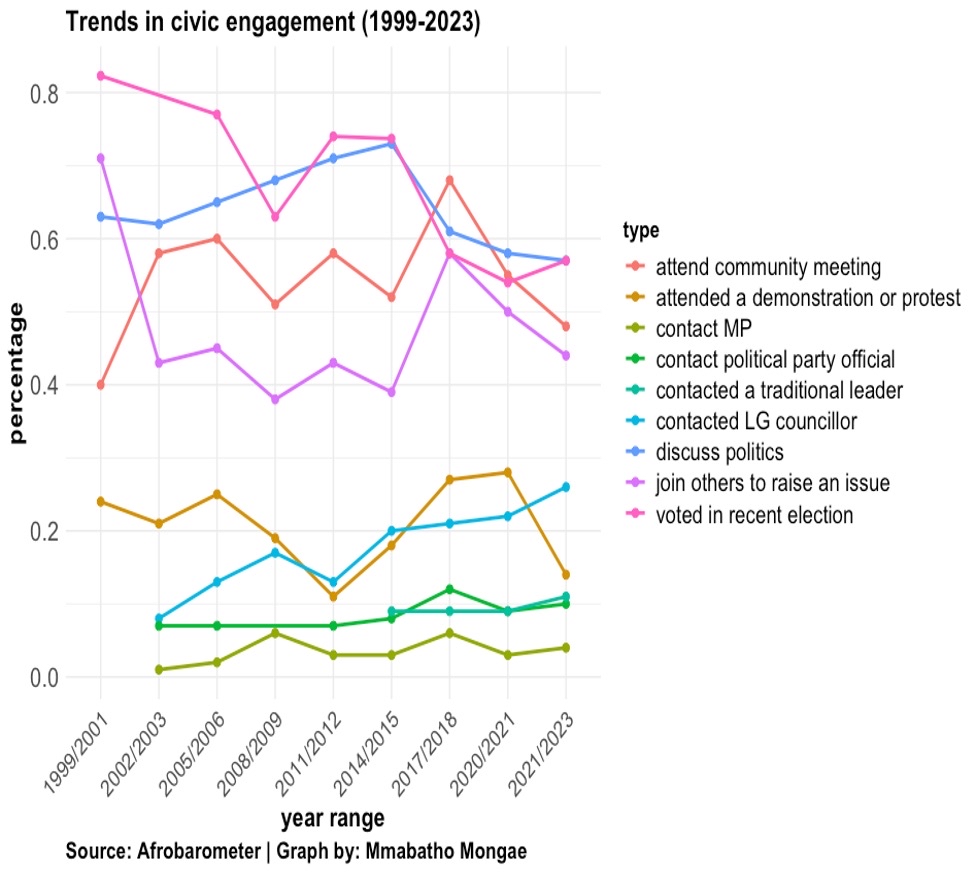
When it comes to civic engagement in South Africa, considerable attention is paid to protest action. However, data indicates that respondents who say they have participated in demonstrations or protest actions have decreased over the years. Between 2017/18 and 2021/23 attendance in demonstrations or protests decreased from 27% to 14%.
The 2015 report by SALGA further highlights the nexus between protest actions and other modalities of civic participation. The findings indicate that individuals who partake in protests are also more inclined to contact their councillors or government officials. This demonstrates that protesters do not solely rely on public demonstrations but also actively engage with governmental entities to instigate change.
Furthermore, the report found that those who regularly communicate with their councillors or government officials tend to believe that their voices are being acknowledged. These findings further highlight the importance of establishing transparent and responsive communication channels between the government and its constituents. It suggests that when citizens perceive their concerns are being recognised and addressed by their representatives, they are more likely to adopt non-violent methods of engagement.
Long-term trends in civic engagement
As depicted in the above graph, long-term trends in civic and political engagement in South Africa are complex. While there has been a general decline across most participation indicators, contact with local government councillors stands out as an exception, showing a steady recognition of local councillors as accessible points of contact for community concerns, especially compared to other tiers of government.
The data also shows two notable shifts from 2020, coinciding with the COVID-19 pandemic:
Firstly, contact with local councillors continued to increase post-2020, possibly due to the need for assistance during the lockdown and service delivery disruptions. Secondly, the decline in demonstrations and protests is likely a result of movement restrictions.
Despite these variations, active forms of participation, such as attending community meetings, protests, community mobilisation, and discussing politics, remain the most prevalent modes of engagement in South Africa. However, the overall decline since 2018 is concerning and may reflect public frustration, political fatigue, or a perceived ineffectiveness of participatory mechanisms.
Lastly, the consistently low levels of direct contact with political leaders point to a persistent gap in state-society relations. This suggests that citizens may not view political elites as responsive or approachable, further entrenching disillusionment with formal political institutions.
The observed trends in civic engagement point to a persistent disconnect between how citizens engage with the state and how the state engages with citizens. South Africans participate through bottom-up, localised, and often informal channels, rather than formalised, institutional mechanisms.
In contrast, the state continues to prioritise institutionalised, top-down models of participation, often through structured consultations, national dialogues, public hearings, or representative forums that may feel distant or inaccessible to many. This divergence limits meaningful democratic engagement, as citizens prefer participatory modalities.
As democracy in South Africa continues to evolve, the state must recognise and integrate community-driven forms of participation. Rather than relying on protests to be heard or treating grassroots efforts as oppositional, leadership should be people-centred and responsive to lived realities.
In a context of deep inequality and institutional mistrust, state responses must be grounded in everyday experiences– flexible to new forms of engagement, and inclusive enough to bridge the widening gap between state and society.
This article first appeared in Mail & Guardian.

Dr Mmabatho Mongae is the acting head of the Governance Insights and Analytics programme at Good Governance Africa (GGA), where she plays a key role in developing innovative, data-driven tools to improve governance and urban management across the continent. Her work includes the Governance Performance Index (GPI) and the African Cities Profiling Project, an initiative aimed at building a comprehensive information bank to assist cities in enhancing service delivery for both citizens and enterprises.
With a PhD in International Relations from the University of the Witwatersrand and as a research fellow at the Centre for Africa-China Studies, Mmabatho’s work bridges rigorous academic research with real-world policy challenges. Before joining GGA, Mmabatho lectured in International Relations at Wits University and received a 2025 M&G 200 Young South Africans award.