
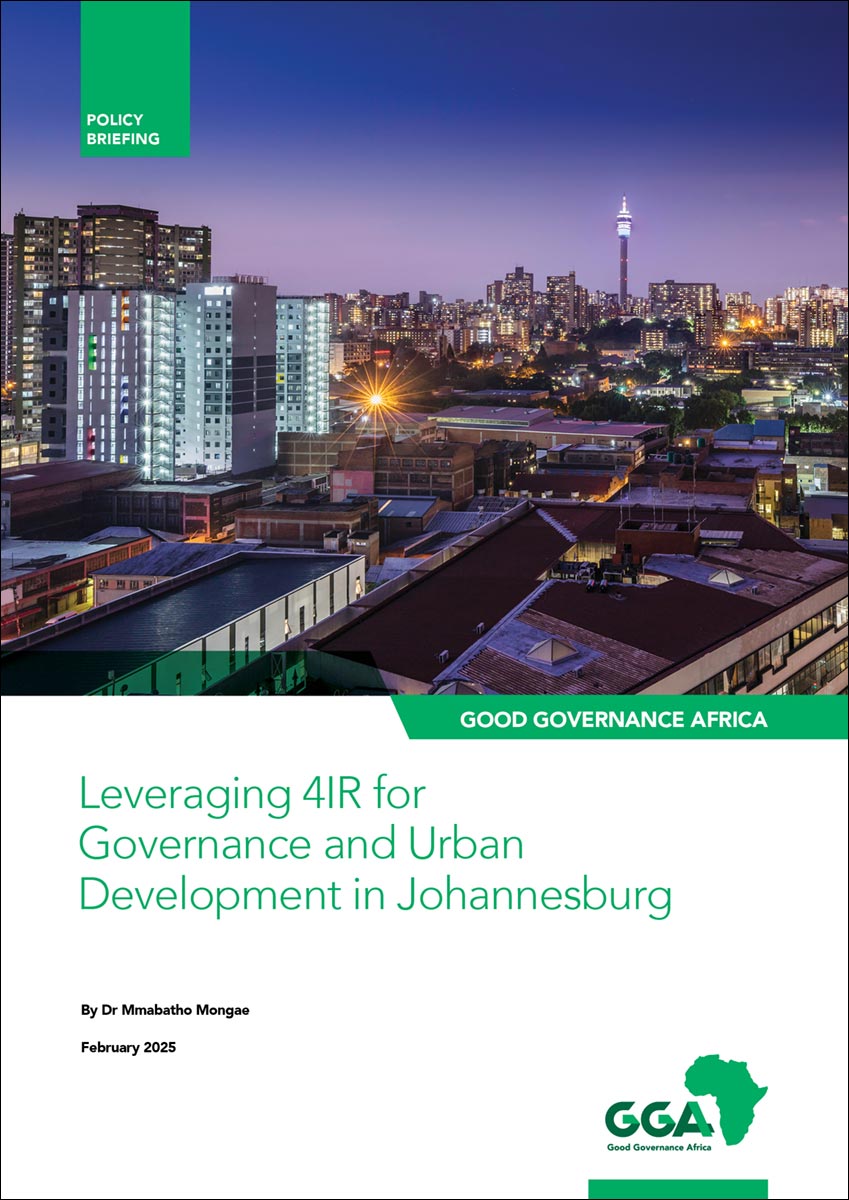
Johannesburg’s ability to harness the transformative potential of the Fourth Industrial Revolution is hindered by persistent governance and administrative weaknesses. While the city scores well for service delivery and economic development, its poor rankings in planning, leadership, and administration on the Governance Performance Index suggest challenges in execution and institutional efficiency. While Johannesburg has demonstrated foresight in adopting 4IR policies – such as the Smart City Strategy – these efforts risk being undermined if governance bottlenecks remain unaddressed.
This briefing highlights the critical role of strong leadership and efficient administration in ensuring that 4IR-driven initiatives do not exacerbate inequality, but instead respond to Johannesburg’s urban challenges.
To maximize the benefits of 4IR, Johannesburg must strengthen governance structures, improve policy coordination, and foster equitable implementation, ensuring that technological advancements enhance service delivery, economic growth, and urban resilience for all residents.

Dr Mmabatho Mongae is the acting head of the Governance Insights and Analytics programme at Good Governance Africa (GGA), where she plays a key role in developing innovative, data-driven tools to improve governance and urban management across the continent. Her work includes the Governance Performance Index (GPI) and the African Cities Profiling Project, an initiative aimed at building a comprehensive information bank to assist cities in enhancing service delivery for both citizens and enterprises.
With a PhD in International Relations from the University of the Witwatersrand and as a research fellow at the Centre for Africa-China Studies, Mmabatho’s work bridges rigorous academic research with real-world policy challenges. Before joining GGA, Mmabatho lectured in International Relations at Wits University and received a 2025 M&G 200 Young South Africans award.