As South Africa prepares to host the G20 Summit for the first time, one of the top concerns is South Africa’s youth, a precarious cohort of the population that, with limited opportunities to strengthen their education and skills development, faces a future of unemployment and hopelessness.
In a virtual information session titled ‘Africa in the G20: Advancing Solidarity, Equality, and Sustainability’, convened by Good Governance Africa (GGA) and moderated by GGA’s CEO Lonwabo Patrick Kulati on 24 July, thought leaders stressed that the power of Africa’s youth will only emerge through unity, industrialisation, and self-determined agency – not symbolic inclusion.
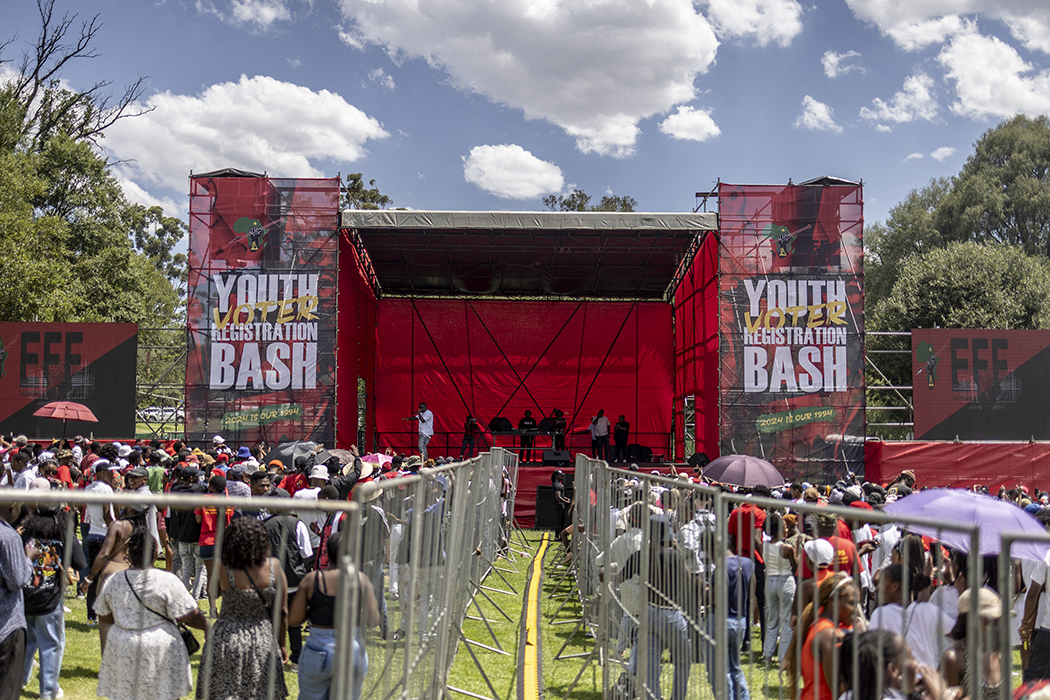
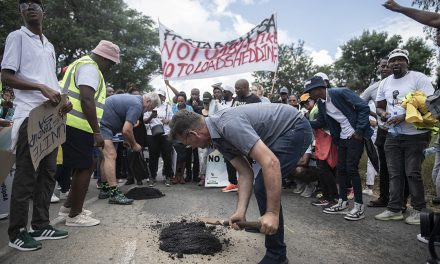
A group of young people gather at the Economic Freedom Fighters (EFF) Youth Voter Bash at Zoo Lake in Johannesburg on December 9, 2023. (Photo by Roberta Ciuccio / AFP)
Sanusha Naidu, Senior Research Fellow at the Institute for Global Dialogue and Associate Researcher based with the Nelson Mandela School of Public Governance at the University of Cape Town, said this requires significant structural investment in education, skills development, and economic inclusion.
“We have a constituency of young people, the only continent in the world that has a youth bulge. The rest of the world is ageing. And if it’s true that we in Africa are not finding the skills, the employment to keep these youth in Africa or be part of skills development, young people are going to look for work everywhere else. In other words, Africa could become the labour workshop for the world,” she warned.
Dr Silvestre Edward Kaweesi of Makerere University warned against surface-level optimism without structural investment in education, skills development, and economic inclusion. “No society has ever risen without industrialising. We must stop celebrating youth bulges without asking: are they educated? Are they skilled? Or are they turning to drugs and despair?”
He also highlighted corruption as a serious obstacle to African agency. “We are too talkative, not practical enough. Annually, Africa loses $100 billion to corruption, nearly the size of Kenya’s entire GDP. That is not the doing of the West. That’s on us.”
The session’s speakers questioned what Africa’s formal inclusion in the G20 truly means. “It’s a club of rich pharaohs, convening to discuss challenges to their fortunes. Our inclusion may be a matter of sympathy, not empowerment,” said Dr Kaweesi.
Addressing the recent reports that senior US officials may skip the G20 Summit, Dr Bob Wekesa of the African Centre for the Study of the United States said their absence “may reflect a broader withdrawal from multilateralism”, referencing past US exits from UNESCO and the UN Human Rights Council.
This wasn’t necessarily negative, he said. “It could embolden Global South alliances like BRICS to play a greater role. But for Africa to benefit, it must consolidate internal strength first.”
- GGA’s second information session will take place on 14 August, titled “Africa in the G20 – Advancing Solidarity, Equality, and Sustainability.” This session will explore how youth can engage in democracy beyond the activism that defined youth political engagement during the apartheid era.
Helen Grange is a seasoned journalist and editor, with a career spanning over 40 years writing and editing for newspapers and magazines in South Africa. Her work appears primarily in Independent Online (IOL), The Citizen and Business Day newspapers, focusing on business trends, women’s empowerment, entrepreneurship and travel. Magazines she has written for include Noseweek, Acumen, Forbes Africa, Wits Business Journal and UJ Alumni magazine. Among NGOs she has written or edited for are Gender Links and INMED, a global humanitarian development organisation.