Many of you operating beyond South Africa will have seen that Tanzania is about to host another sham election. This is part of a broader problem that we refer to as ‘democratic backsliding’. It’s not only an African phenomenon, of course, but it is particularly worrying for countries that have never truly consolidated their democratic gains.
Tanzania, for instance, has had whispers of democratic emergence since independence, but has failed to pass one of the standard tests of democracy – the turnover test: if the incumbent has lost power and peacefully accepted the result of a free and fair election, we can judge a country to have passed this minimalist test. South Africa has passed, though arguably the incumbent continues to behave as if it were an outright election winner.
Tanzania’s ruling party, the Chama Cha Mapinduzi (CCM), has effectively eliminated the two major opposition parties. It was hardly subtle about it either. Using a classic dictatorship strategy, they jailed the leader of the main opposition party – Chadema’s Tundu Lissu – on trumped-up treason charges. So, while Tanzania has ostensibly democratic institutions – elections and a legislature – these are essentially means of gathering information to further authoritarian ends. It is a form of electoral authoritarianism.
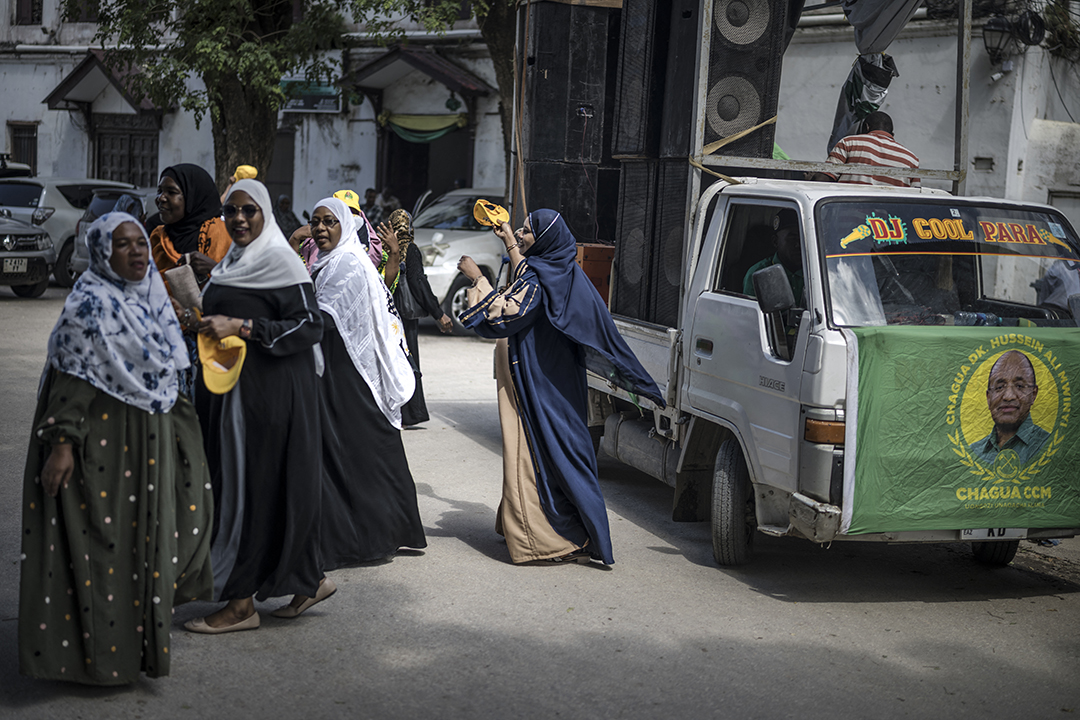
Supporters of Zanzibar President-elect Hussein Ali Mwinyi of the ruling Chama Cha Mapinduzi (CCM) dance as they celebrate his re-election in Stone Town, on October 31, 2025. (Photo by MARCO LONGARI / AFP)
Dictators (or incumbent parties) typically utilise an array of state resources to maintain an iron grip on power. Their calculus is effectively that the costs of reform towards political and economic openness outweigh the benefits of the status quo, in which they access rents and use those rents to repress civil liberties. As the Economist Intelligence Unit’s (EIU) latest Democracy Index (2024) points out, “Across (Southern Africa), an increasing number of governments have resorted to internet shutdowns and restrictions on political demonstrations as a means to suppress dissent… countries that experienced internet shutdowns in 2024 included Chad, Ethiopia, Kenya and Tanzania.” Norway scored 1st with a score of 9.81 (out of 10) – no one can be perfect. Tanzania, by contrast, scored 5.20, ranking 86th out of 167, classifying it as a “hybrid regime” that combines “elements of electoral democracy with authoritarian behaviours”. All indexes are relative, so despite an obvious decline, its rank remains unchanged from 2023.
On Freedom House, Tanzania scores a dismal 35%: “After a period of some liberalisation, President Hassan has begun to resort to similarly repressive tactics (to her predecessor, John Magufuli).” The 2024 V-Dem score for Tanzania is 0.415, placing it squarely in the “Electoral Autocracy” category. Putting the country on “Negative Watch”, the EIU succinctly notes that Tanzania’s upcoming general election, among others, is “likely to be stage-managed to keep incumbents in power.”
It seems to me that in cases like this, incumbents like Hassan feel pressure to tighten the noose on civil liberties, either because the party fears that it may otherwise lose power or because Hassan herself needs to satisfy elements of her party that she is sufficiently willing to move in this direction in exchange for their support. Her executive still maintains “significant influence over the electoral structure and decision making”, according to researcher Nicodemus Minde.
So what? Well, the operating environment for mining firms is determined by these kinds of political dynamics. Even though mining is a long-term game, it does not escape shorter-term political volatility but has to live through it. Paradoxically, the 2025 Fraser Institute Survey’s Investment Attractiveness Index shows an improvement in Tanzania from a score of 42.08 in 2020 to 62.75 (out of 100) in 2024. It is often easier, initially, to do business in dictatorial jurisdictions. My own PhD thesis showed that between 2004 and 2007, a set of Asian National Oil Companies preferred to do business in Angola rather than in Nigeria, despite the latter having opened up remarkably since Abacha’s death in 1998. In Angola, dos Santos had ensured that the national oil company operated proficiently, and in the end, that gave more certainty to investors than Nigeria’s volatility (and a highly corrupt national oil company).
However, the historical data strongly suggest that successful democratisation invariably wins the day for aggregate economic performance. This is because responsible businesses can thrive only in situations where governments are effective, while also being held to account by their citizens. While it may seem easier to simply pay rents to political elites for the right to extract resources, those rents are often used to erode the quality of the overall business environment.
Mining companies often have to behave like diplomats walking on hot coals – if they speak up against the suppression of civil liberties, for instance, they risk losing their licence to operate. If they don’t speak up, they may lose their social licence anyway, or at best inadvertently prop up a regime that is bent on extracting rents and entrenching its power. I don’t have any easy answers here, but it is at least incumbent on mining companies to think about what kind of collective impact they want to have on the overall operating environment. Democratic backsliding hurts everyone in the long run; it might well be worth thinking about what kind of resources can be allocated towards preventing it.
This article first appeared in Modern Mining magazine.

Dr Ross Harvey is a natural resource economist and policy analyst, and he has been dealing with governance issues in various forms across this sector since 2007. He has a PhD in economics from the University of Cape Town, and his thesis research focused on the political economy of oil and institutional development in Angola and Nigeria. While completing his PhD, Ross worked as a senior researcher on extractive industries and wildlife governance at the South African Institute of International Affairs (SAIIA), and in May 2019 became an independent conservation consultant. Ross’s task at GGA is to establish a non-renewable natural resources project (extractive industries) to ensure that the industry becomes genuinely sustainable and contributes to Africa achieving the Sustainable Development Goals (SDGs). Ross was appointed Director of Research and Programmes at GGA in May 2020.