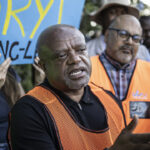

France, Paris, 2022-02-05. A woman selling flags and posters during the demonstration, Place de la Bastille, organised by Urgences Panafricanistes and M5RFP FRANCE in support of the peoples and perpetrators of the coups in Burkina Faso, Mali and Guinea. Photo: Amaury Blin/Hans Lucas/AFP.
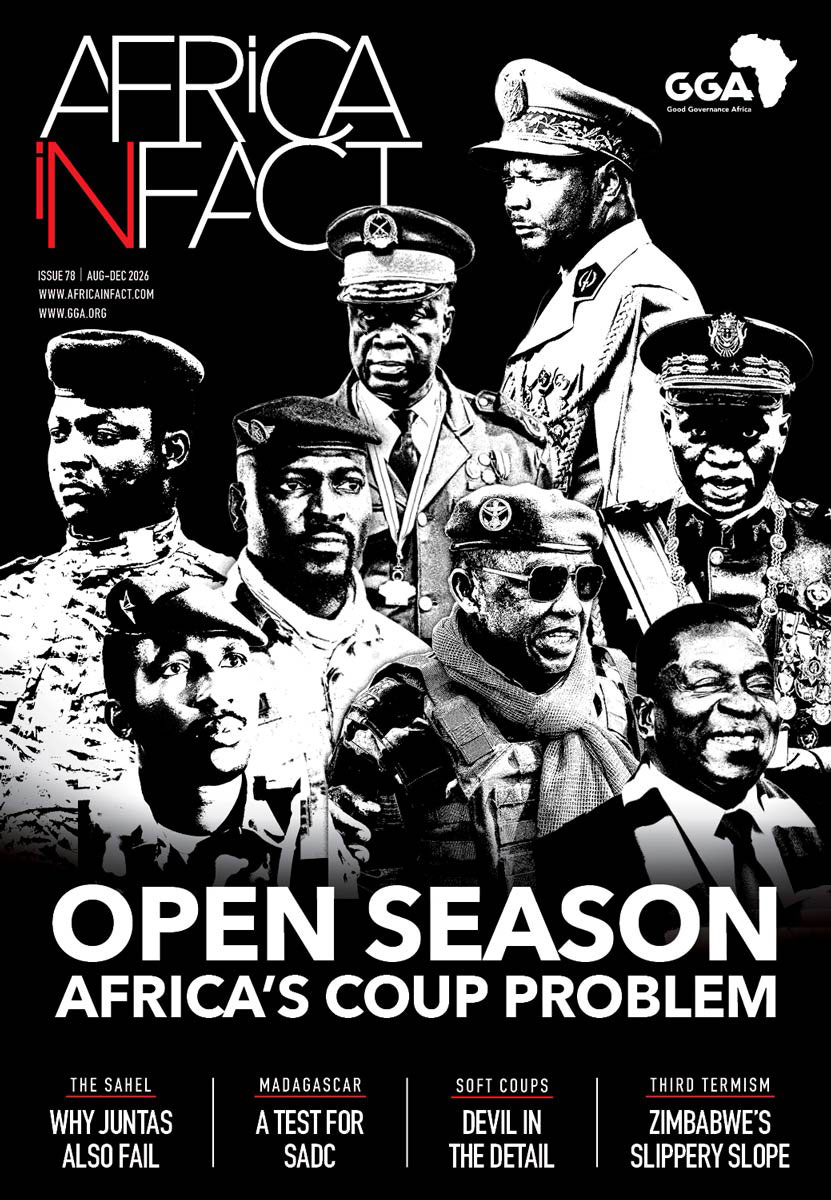
In recent years, West Africa has seen a spate of coups and attempted coups. Efforts by governance actors in the region to prevent these incidents have been largely ineffective. Coups are not the only security threat facing the region, and are just one of a variety of emergent challenges, including religious extremism, drug trafficking, and other transnational crimes. Common to these different security threats, however, is that they are a result of the systematic and sustained weakening of constitutional and democratic governance structures.
In a study by security scholar, Patrick J. McGowen (2005), the author lists a total of 44 successful military led coups, 43 failed coups, many of them bloody, 82 coup plots, and seven civil wars and other forms of political conflicts between the years 1955 and 2004. However, the post-2000 era has been a much more stable period, with a significant decline in the number of annual coup attempts. This trend has been reversed with the recent spate of coups in the region.
At the national level, factors such as decline in economic growth, deepening inequality and rising frustration among the citizenry, as explained in one of GGA-West Africa’s latest research studies titled Review of the Security Situation in the West African Sub-Region: Advocating for Security Improvement to Promote Regional Development, have undoubtedly added to political volatility in the region. In countries where economic growth has occurred, only a politically-connected few have benefitted, while the gap between rural and urban populations has continued to grow, with rising levels of inequality seen within healthcare and education. The combined effect of poverty and the ostentatious lifestyle on public display by many in the political elite (a typical example is the lifestyle of the son of the president of Equatorial Guinea, Teodoro Nguema Obiang, which has come under scrutiny recently), further drives frustration and the belief that the military is the most viable option to bring about change in the short term.
West Africa’s youthful population, which should propel production and economic growth, is becoming a liability in the face of low levels of employment. With the global rise in religious and violent extremism, youth populations have become a target for recruitment. A lack of clarity around land ownership, and the political and economic marginalisation of peripheral regions, have also added to general instability and consequent public dissatisfaction.
Even in relatively safe, stable and secure West African states such as Ghana, such threats do exist. A typical example is the troubled area of the Upper West Region of Ghana, where age-old have been reignited, causing citizens to worry over the possible infiltration of jihadist fighters from nearby Burkina Faso. This has resulted in the heavy deployment of military personnel and equipment to monitor and arrest any such developments – a heavy toll on the already suffering economy.
As was the case in Guinea, elements within the military capitalised on public dissatisfaction and, with support of foreign paymasters, were able to oust President Alpha Conde. The covert influence of foreign governments, particularly former colonial masters, in influencing the governance style of free states in West Africa has been cited as one of the factors leading to the breakdown of democracies in the region. France’s influence in French speaking states in regions like Cote d’Ivoire, Mali and Burkina Faso has been condemned following political disturbances in these countries at different periods.
While coup leaders have presented their actions as necessary for the protection of the state or the constitution, evidence shows that coup regimes regularly fail to improve economic and developmental standards. Moreover, militaries in the region have a poor track record when it comes to good security sector governance. While recent incidents have placed focus on military coups in the region, it is also important to highlight the rise in ‘constitutional coups’, where democratically elected leaders in the West African region change their respective constitutions to perpetuate their stay in power. A case in point is President Alassane Ouattara of Cote d’Ivoire. In August 2020, President Ouattara, who has been in power since 2011, reneged on his earlier agreement to step down, arguing that his first two term mandates do not count because the country adopted a new constitution in 2016.
Incidents like these could easily trigger another coup, as we have seen in other West African states. President Ouattara is not the only president to attempt changes to the constitution to extend his term limits, and similar actions have been taken by President Gnassingbe of Togo, former President Conde of Guinea, former President Yahya Jammeh of the Gambia, and President Paul Biya of Cameroon.
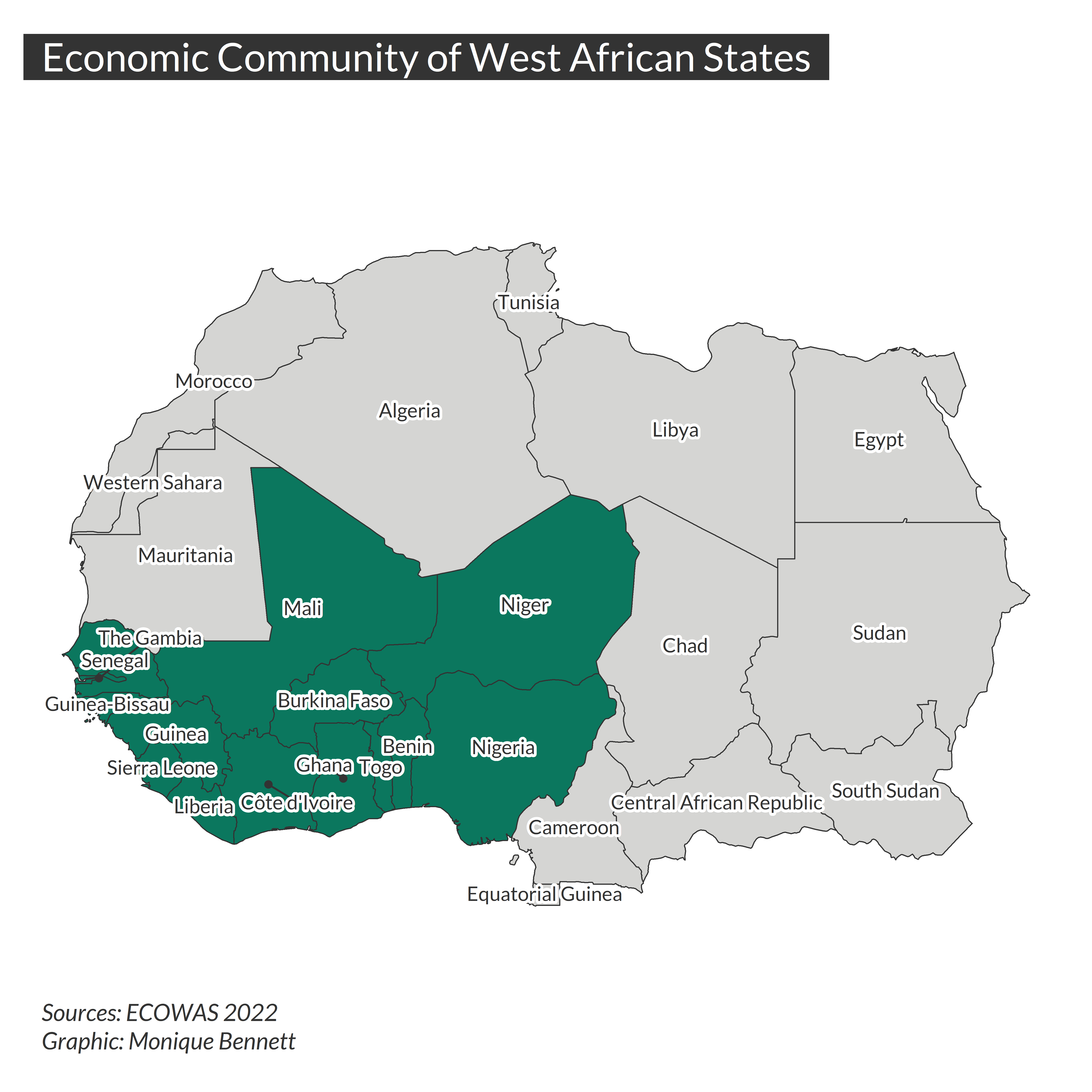
The weakened oversight role of continental and regional bodies such as the African Union (AU) and the Economic Community of West African States (ECOWAS) has a direct impact on the prospects for lasting peace and stability in the region. The ability of such bodies to guide member states to stay on the path of democratic governance and prevent coups should be an urgent priority. The recent flagrant disregard of ECOWAS directives to return to constitutional rule, by military governments like Mali and Burkina Faso, should precipitate significant reforms in the regional body’s modus operandi.
At the recently held Extraordinary Summit of the ECOWAS Authority of Heads of State and Government in Accra, Ghana, the Authority affirmed its commitment to stand firm for the protection of democracy and freedom in the region, and reiterated its resolute stance in upholding the principle of zero tolerance of ascension of power through unconstitutional means.
However, until this call (protection of the tenets of the constitution of individual states) is supported by all governance actors in the region, and the protocols of the regional body are fully implemented and respected by member states, political instability will likely remain.
[activecampaign form=1]

Tina Serwaa Asante-Apeatu is an accomplished governance and development expert with over 20 years of leadership experience advancing democratic accountability, institutional strengthening, and public sector reform in Ghana and West Africa. She currently serves as the Executive Director of Good Governance Africa – West Africa Regional Office (GGA-WARO), where she leads regional research, policy advocacy, strategy development, and stakeholder engagement.
Tina has a distinguished record in organisational leadership, programme design, monitoring and evaluation, and governance innovation. She has worked extensively with governments, civil society, development partners, and research institutions to promote transparency, the rule of law, and citizen participation.
She previously held senior roles with the Friedrich Naumann Foundation and the African Evaluation Association (AfrEA), supporting governance programming, capacity building, and international convenings. As former National President of the Police Wives’ Association (POLWA), she successfully formalised the organisation and led nationwide women’s empowerment programmes.
A multilingual professional (English, French, German, Twi, Ga), Tina brings strong cross-cultural communication, strategic insight, and high-level advisory experience to board engagements.
Currently, she sits on the Governing Council of the Ghana Anti-Corruption Coalition

Gifty Obeng is a monitoring and evaluation specialist with over 19 years’ experience in various fields of work. With an international training background (Masters level) in sustainable environmental practices, Gifty specialises in designing programmes and projects that protect the environment and thus limit the negative environmental footprint of human activities. She has been at the forefront of advising agencies like the B-Bovid (agro-processing social enterprise) on sustainable agricultural practices and climate change adaptative measures for farming communities. Gifty’s commitment to the use of best planning practices in all initiatives she has supported stems from her training as a development planning professional at undergraduate level (see CV). A trained school teacher with more than 10 years’ experience, Gifty is also skilled in training and mobilising stakeholders with various needs, and in designing content to suit various categories of clients. Gifty currently occupies the position of Programmes, Monitoring and Evaluations Manager at the Good Governance Africa Centre, where she uses her strong professional training background in business administration (Big Data), Quick Books and ComCare to steer programmes and activities.

Edward is a development planning professional with over 10 years working experience in development cooperation, research and training. For six years, Edward worked as a technical development advisor working at all levels of the decentralised system in Ghana. At the local level, he has been directly involved in community mobilisations and engagements to document the needs of the people mostly in deprived districts. These engagements were further used to enrich national policy discourse and in the formulation of policies and programmes. Edward also coordinated interventions with the then 10 Regional Coordinating Councils (RCC) to support selected districts in the implementation of their development programmes. Over the last five years Edward has been engaged in trainings and research, working both in the private and non-governmental sectors. With a strong planning background both at the masters’ and undergraduate levels, Edward is a passionate advocate of inclusive planning and decision making, particularly on matters that could reduce poverty amongst marginalised segments of society. Edward also holds a practitioner certificate in organisational and systems development; a background that positively influences his engagement with stakeholders at all levels of society. Currently, Edward occupies the position of Senior Research Officer at the Good Governance Africa – West Africa Centre (see CV).