There is no shortage of literature on the qualities of a good leader. Yet, in governance spaces across the public and private sectors, good leaders are scarce enough to wonder why there’s such a profound deficit in them, and if we might be missing something.
The ideals of good leadership are encapsulated by the King IV Code on Corporate Governance’s “ICRAFT” principles – Independence, Competence, Responsibility, Accountability, Fairness, Transparency – but identifying and appointing individuals with these markers is an altogether more complex business, one that is also loaded with the inescapable reality that even the best among us are only human after all.
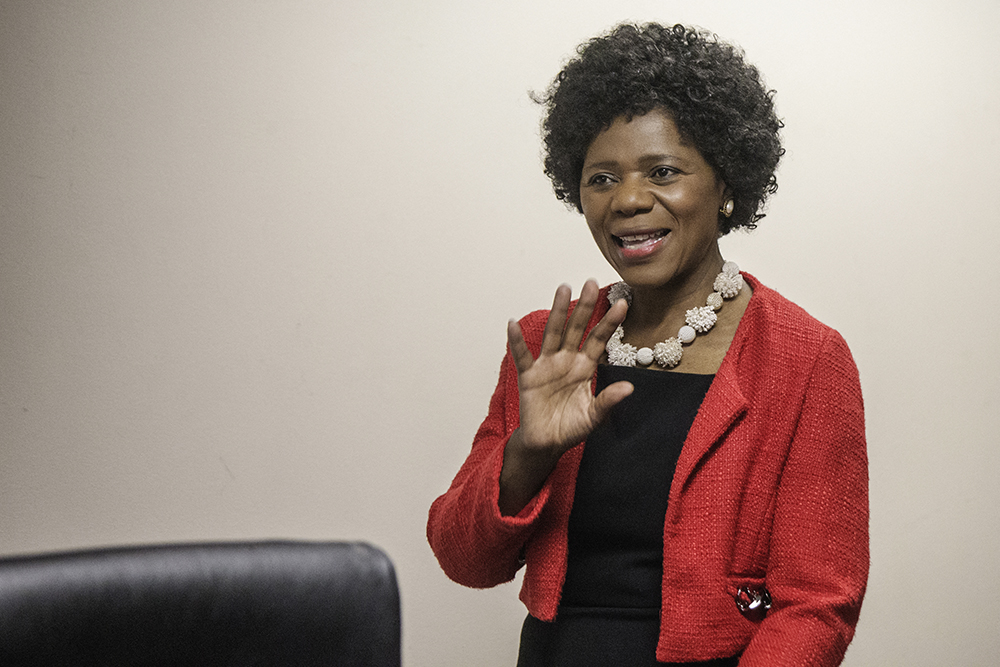
Former South African Public Protector Advocate Thuli Madonsela. Photo by GIANLUIGI GUERCIA / AFP
One of the worst habits of South African boards, committees and councils is habitually filling senior positions with “recycled underperformers”, according to Tuesday Consulting, an executive search and advisory firm.
“Driving this is a deep fear of change. Many institutions, especially those under pressure, make decisions based on familiarity. They tend to reach for individuals within their networks or people they’ve worked with before, not necessarily because they’re the best fit, but they feel like the safest choice, reputationally or relationally. And we’ve got to challenge that cycle,” Tsholofelo Nketane, Director Executive Search at Tuesday Consulting, told Jeremy Maggs on Hot102.7fm radio earlier this month.
The consequence of this so-called ‘revolving door’ phenomenon is poor governance, including enabling corrupt actors. As the King IV Code notes, it entrenches power, reduces independence, weakens accountability, and shuts out diversity, making governance ineffective and ethically questionable.
Not only that, if you zoom out to the macro view, it serves to concentrate power among an elite few, who are prone to using a mix of wealth accumulation and political clout to serve their own interests, with no regard for the economic welfare of others. As the late Douglass North put it, political and business elites are prone to extract rents at as low a cost as possible to themselves, and then distribute them as required to prevent revolution, literally entrenching the elite bargain at the expense of the majority of citizens.
We have more than enough examples of how pernicious and out-of-control this can get. As Minister of Public Enterprises, Malusi Gigaba systematically placed Gupta-linked individuals into key positions within state-owned enterprises (SOEs), including board appointments at Transnet, Eskom, Denel, and SAA. These appointees often had dual allegiances, serving both government interests and private corporate interests, enabling him to funnel state contracts to Gupta-connected entities. The fundamental governance risk here is that the Minister gets to appoint the board – this needs to be urgently changed to ensure diverse interests select boards.
Beyond the fact that cronyism undermines accountability, morale is insidiously undermined when staff see leaders appointed not for competence or alignment with corporate values, but for who they know. It fosters a sense that advancement is about connections, not merit, which in turn erodes productivity, employee loyalty, and organisational integrity.
“Ultimately, appointing the right leader builds trust within the organisation and within the team being led. People want to know that they are not only getting a credible or competent leader, but one who’ll be able to make the right and tough decisions,” said Nketane.
Getting this right takes a considered decision at EXCO or board level, she said. “Appointing a leader is not a box-ticking HR process. It should actually be a top-level decision, one that aligns with your strategic objective in the long term. And of course, doing the checks is critical,” she said.
By checks, Nketane means rigorous psychometric assessments, which look for cognitive agility, behavioural style, emotional intelligence, motivation, and development potential. The goal is not just “Can you do this job now?” but “How will you think, behave, and grow in the organisation’s future context?”.
In addition, a deep review of the person’s past and the skills they bring need to be done, she said. “You are not just sitting across the table and having a conversation, but verifying the information that the individual is giving you. It entails doing formal and independent, informal reference checks.”
Appointment criteria also need to consider the skills leaders need to steer the organisation into the future. Digital literacy, for one, has evolved into an essential skill at leadership level, and this increasingly includes demonstrative ability in the use of Artificial Intelligence (AI). Here again, the slow uptake of future-fit leaders, particularly those with potentially industry-disruptive ideas, shows a problematic preference for the familiar.
“Innovative ideas often face resistance, manifesting in phrases such as ‘That’s not how we do things around here’ or ‘Now’s not the right time for that’,” commented Dhatchani Naidoo, MD at strategic management consultancy, Delta Victor Bravo, in an interview with BusinessLIVE.“The courage to challenge the status quo is often stifled by risk aversion, which in a world changing faster than ever, may be the riskiest strategy of all,” she said.
Skill and enterprising vision aside, the ability to create and maintain a cohesive, loyal team will always lie at the essence of good leadership, not least because the psychological safety of staff is strongly correlated with performance, innovation, and resilience. As Harold Koontz, an American management theorist, said, “Leadership is the art of influencing people so that they can work willingly towards the goals.”
To this end, psychometric tests subtly look for interpersonal skills through layered questions based on the Big Five personality model, which research shows predicts workplace behaviour. These are openness (creativity, adaptability, intellectual curiosity), conscientiousness (organisation, responsibility, reliability), extraversion (sociability, energy, assertiveness), agreeableness (cooperation, empathy, trust), and emotional stability (resilience, calmness, stress management). On extraversion, a book released last month, titled Quiet Power: Leadership for Introverts, by Adella Pasos, speaks to how our loud, extrovert‑centric world often overlooks the deep, insightful contributions of quieter thinkers, so the other four indicators are crucial balancers here.
Still, data-driven tests have their limitations, and this is where the judgment of seasoned bosses and recruiters comes into play, as they are usually able to read intangibles like authenticity, chemistry, gravitas, and alignment with organisational values. Best practice is to use both: psychometrics as a foundation, and informed instinct/judgement as a refinement tool.
“No single psychometric assessment should ever be used on a stand-alone basis for selection decisions. Assessment tools don’t ‘make decisions’, but rather provide information for human decision makers,” states the executive selection guideline published by the Association of Executive Search and Leadership Consultants (AESC).
With all this rigorous leadership science, backed by best practice guidelines, it makes no sense to continually fall into the ‘revolving door’ trap.
Well-chosen leaders can be game changers. Two examples in public governance shine out; Thuli Madonsela, Public Protector from 2009 to 2016, and Mogoeng Mogoeng, Chief Justice of South Africa from 2011 to 2021. Both these leaders were chosen outside of political patronage networks, and were impactful because they courageously pushed for discipline and ethical leadership, often against significant pressure to do otherwise.
There are also examples in the corporate space; Maria Ramos, former CEO of Absa and Transnet, and Adrian Gore, founder and long-time CEO of Discovery, both transformational, visionary leaders who proved highly adaptable to evolving markets.
At their very core, good leaders are those who set high standards for themselves, the ones who lead by example. Ultimately, then, the quest for quality leadership circles back to an appreciation of those who make ethical, responsible choices in their own lives, beyond their professional personae. As Mahatma Gandhi observed, “You must be the change you wish to see in the world.” These are the leaders we need to find, groom, and appoint.
This article first appeared in Mail & Guardian.

Helen Grange is a seasoned journalist and editor, with a career spanning over 40 years writing and editing for newspapers and magazines in South Africa. Her work appears primarily in Independent Online (IOL), The Citizen and Business Day newspapers, focusing on business trends, women’s empowerment, entrepreneurship and travel. Magazines she has written for include Noseweek, Acumen, Forbes Africa, Wits Business Journal and UJ Alumni magazine. Among NGOs she has written or edited for are Gender Links and INMED, a global humanitarian development organisation.