Escalating tension between the United States (US) and Israel, on one hand, and Iran, on the other, amid unproductive negotiations on Iran’s nuclear programme in February this year, has shifted geopolitical dynamics.
An organised, large-scale military offensive by the US and Israel targeted Iran’s leadership, military forces and intelligence networks, including missile and nuclear infrastructure. This was purportedly to force regime change and weaken Iran’s nuclear capabilities after failed indirect negotiations hosted in Geneva and mediated by the US in February.
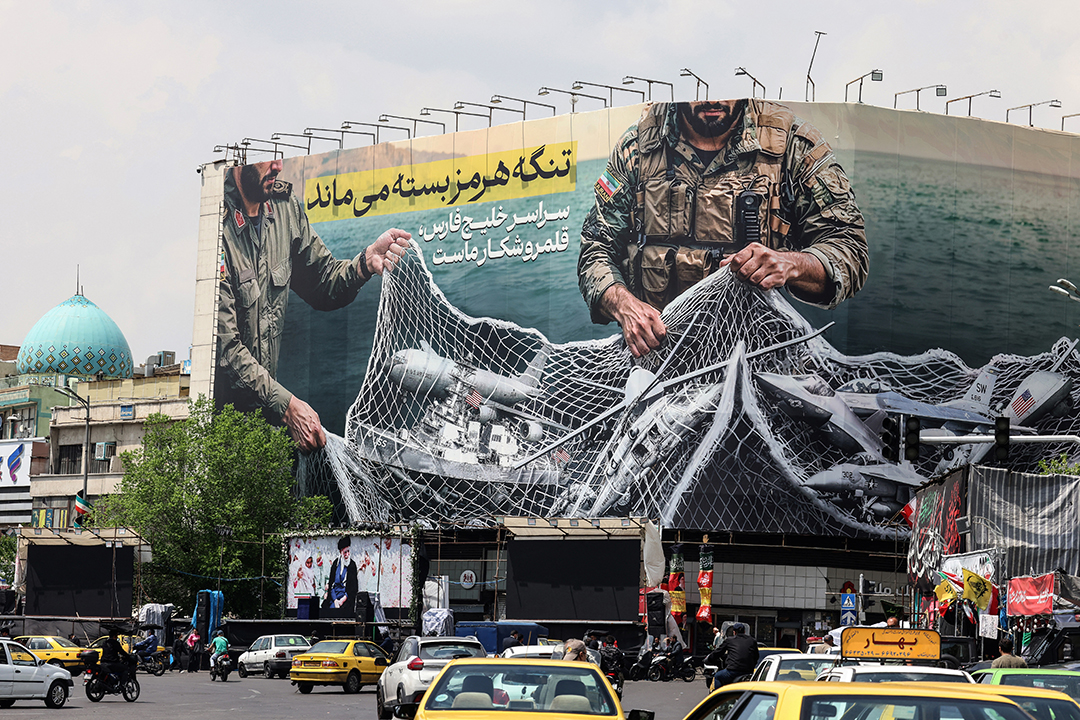
A giant billboard reading ‘The Strait of Hormuz remains closed’ at the Revolution Square in Tehran on April 22, 2026, amid a ceasefire in the region. Photo by ATTA KENARE/AFP
In the Geneva talks, US President Donald Trump set out a deal to constrain Iran’s nuclear programme, though Iran was determined to continue the use of uranium, insisting on what it sees as its right to enrich uranium and, therefore, was not prepared to meet Trump’s terms. After the collapse of talks in Geneva, joint US-Israel threats to attack Iran materialised on 28 February, when Operation Epic Fury (US) and Operation Roaring Lion (Israel) launched widespread airstrikes across Iran that killed Iran’s Supreme Leader, Ayatollah Ali Khamenei.
Subsequently, civilian infrastructure, including schools, hospitals and heritage sites, was severely damaged. A death toll of more than 2 000 civilians continues to mount. Iran reacted with missile and drone strikes targeting US military facilities in the region, Israel, energy and civilian infrastructure in the Gulf states. It launched hundreds of drones and ballistic missiles in Bahrain, Jordan, Kuwait, Qatar, Saudi Arabia and the United Arab Emirates.
Where African economies stand
Consequently, the conflict resulted in Iran closing the Strait of Hormuz, a critical export route for global oil and liquefied natural gas (LNG) shipping. The strait is a 55km-wide, 16km-long commodity corridor between Iran and Oman, separating the Persian Gulf from the Arabian Sea. It is the world’s most strategically significant shipping route and an important part of the global economy.
This blocked waterway has restricted exports of approximately 20-30% of the world’s oil and gas, and, in turn, has fuelled a significant increase in global fuel prices. This is proving to be a severe exogenous shock to multiple countries and several global commodities markets. Specifically, the war raises questions of energy accessibility and security for African countries.
This is a priority pillar for African nations: securing energy for their people and economies and being critical players in global energy markets. The closure of the strait has exposed systemic and operational limitations in the African oil and gas industries. On the one hand, countries such as Nigeria and Ghana have short-term revenue gains from higher crude prices. However, these gains are challenged by structural difficulties.
Ongoing constrained domestic refining capacity highlights that oil-rich countries remain dependent on imported refined fuels. Additionally, limited domestic production capacity and old infrastructure have prevented African oil-producing countries from quickly scaling production to suit current energy market conditions.
On the other hand, many African countries rely heavily on imported fuel, and rising oil prices have led to higher transportation costs, higher food prices, and broader inflation. Evidently, the disruption of global energy supplies has had immediate negative effects on many African economies.
For instance, South Africa continues to face rising fuel import costs, shipping delays and increased insurance premiums as vessels are rerouted around the Cape of Good Hope. These rerouted vessels, in turn, pose a potential long-term benefit by shifting global trade towards Southern Africa’s waters.
Key economic industries, including mining, agriculture, and manufacturing, have suffered due to associated logistical challenges. Beyond South Africa, other African countries have also experienced the drastic effects of rising fuel costs and remain vulnerable.
An opportunity for African countries
The closure of the Strait has underscored the Middle East’s importance and the significant role it plays in the global economy. It is effectively at the centre of energy production, financial networks, logistics infrastructure and trade routes, particularly with the African continent.
Middle East-Africa relations have continued through investment, finance, labour migration and trade logistics. Shipping routes linking the Gulf to the Red Sea and the Mediterranean are critical for African trade. With this background, Africa should push for enhanced regional coordination and take this chance to strengthen ties with the Near East without further complicating its already strained relationship with the US.
On a continental scale, West and Central African oil producers such as Nigeria and Angola have an opportunity to strengthen intra-African crude and refined product trade through pipeline networks and shared refining hubs. Given that these countries, including Libya, export crude and re-import refined fuels at higher prices, regional blocs should coordinate investments in refineries that serve multiple countries.
This would reduce exposure to the volatility of global oil prices and build interdependence among African economies, in the same way that regional energy grids operate in more coordinated markets such as the EU. The crisis should also create momentum for strengthening regional trade frameworks, particularly under the African Continental Free Trade Area (AfCFTA).
As indicated, disruptions to global shipping routes have highlighted the vulnerability of Africa’s overreliance on imported fuel via now-costly trade corridors. This should encourage African governments to develop an intra-African supply chain. For instance, landlocked countries such as Zambia and Zimbabwe could benefit from coordinated transport agreements that streamline the movement of fuel and essential goods from coastal hubs such as South Africa and Mozambique.
Coordinating customs procedures, reducing border delays and investing in regional transport corridors would mitigate current disruptions and build long-term resilience against future global shocks. In the logistics sector, the disruption illustrates an opportunity for collaborative innovation among African freight and transport players.
Organisations such as the Southern African Association of Freight Forwarders are already positioned to lead efforts in coordinating alternative shipping routes and transport systems. For instance, rerouting cargo around the Cape of Good Hope requires highly strategic port operations, rail connectivity and inland distribution networks across multiple countries. Ports in Durban, Walvis Bay and Maputo can function as a coordinated network and improve efficiency by reducing congestion. This collaborative effort would enable a more integrated continental logistics ecosystem.
Importantly, the crisis creates a strategic opening for regional cooperation in energy diversification and industrial development across the continent. Countries across Southern and East Africa should jointly invest in renewable energy projects, regional gas pipelines and shared storage facilities to reduce dependence on volatile global oil markets. Gas development between Mozambique and neighbouring countries could supply cleaner energy to the region while supporting industrialisation.
Further to this, joint procurement mechanisms for fuel are a strong starting point to enhance bargaining power and stabilise prices. For African countries, the global disruption of the Iran war should be viewed as a reset moment. African nations should take this opportunity to move towards more deliberate, deliverable regional cooperation that is less susceptible to external shocks and better positioned for a secure energy supply.
Africa’s response will require stronger collective political will and the ability to act decisively, despite competing national interests that often work against incentives for regional cooperation.
This article first appeared in Mail & Guardian.

Busisipho Siyobiis a public policy researcher with a focus on the intersection of mineral resource governance and climate change in Southern Africa. Her research focuses on advancing the integration of Environmental, Social, and Governance (ESG) factors and social performance within the extractive industries and shaping climate change response strategies that foster sustainability. She leads a programme team in developing and executing the research strategy on mineral resource governance and climate change. She works closely with civil society, industry, and international organisations in this capacity to promote good governance, transparency, and accountability to enable sustainable investment and development. Busisipho holds a Master of Philosophy in Public Policy from the University of Cape Town.