The biggest story in Eswatini in 2024 – written by South African journalists Micah Reddy and Warren Thompson – revealed how two Canadian brothers established a bank in the kingdom through evidently corrupt means.
Despite the process being repeatedly red flagged by the regulator, Eswatini Central Bank, the brothers were granted a banking licence in 2018, in part through pressure exerted by political players close to King Mswati III, the story revealed.
For the investigation, Reddy and Thompson relied on 890,000 leaked internal records from the Eswatini Financial Intelligence Unit (EFIU), which monitors financial crimes. The journalists travelled to the kingdom to interview people connected to the case – and waited a long time for responses after granting right of reply to people implicated in the investigation.
Finance minister Neal Rijkenberg, currently serving a second term in his post, was one of those implicated. The story detailed links Rijkenberg had with the bank and the role he might have played in its getting an operating licence. When the two journalists sent him questions, Rijkenberg said he would not comment on information illegally obtained.
The story was published anyway and quickly travelled. It was on many people’s social media timeline and was shared across WhatsApp and other messaging platforms. For many days it was all some people talked about – those that followed the news – in Eswatini and in the country’s diaspora. Even Esquire magazine, in September 2024, published a full article about the case.
Member of Parliament, Welcome Dlamini, an ally of the finance minister, was one of the first to make the matter public. Through a motion in the National Assembly, he demanded that action be taken against those who had leaked EFIU documents; and gave the finance minister seven days to report to Parliament about action taken to deal with the whistleblowers.
The Times of Eswatini, in a November 2024 article that did not mention the corruption that international media had highlighted, reported that the central bank had issued the Farmers Bank management with a notice of revocation letter.
It is difficult to make the argument that it was attention brought about by the work of the two journalists that led to this notice of revocation. And an official or final revocation, published in the government gazette, has not been issued.
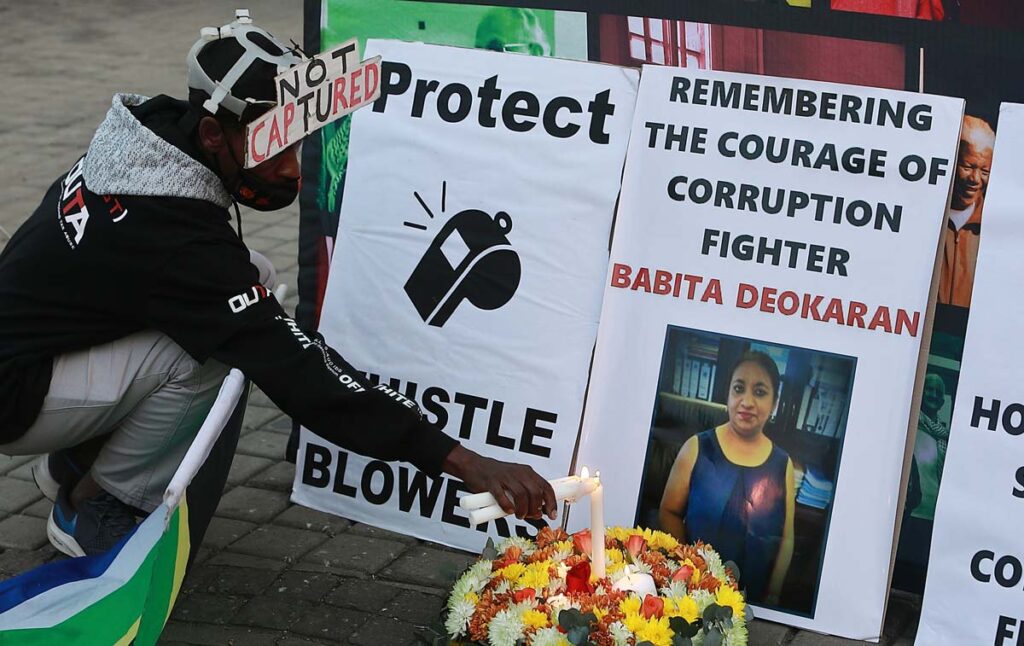
A memorial service for murdered South African whistleblower Babita Deokaran. Photo: Fani Mahuntsi / Gallo Images via Getty Images
And it was not the first time the licence had been revoked. Issued in 2018 initially, the licence was first cancelled in October 2020. There had been no investigative story prior to that.
Another story whose core was corruption, and also from 2024, was written by Dane Armstrong and myself. Michael Lee Enterprises, a company named after its Taiwanese founder, was in September 2022 granted a licence to prospect for and mine green chert within Malolotja Nature Reserve, a protected area in the Eswatini Highveld.
In February 2024, following the king’s visit to the mining site, the government granted Michael Lee Enterprises a mining licence, claiming that the company had successfully completed a prospecting phase. This, despite the project being red-flagged for potential environmental damage by the Eswatini Environmental Authority before and during prospecting.
Furthermore, the Environmental Assessment Regulations of 2022 allow mining to go ahead only after the environmental authority has issued an environmental compliance certificate. Without one, the miners went ahead and mined, shipping thousands of tonnes of the green chert abroad and failing to account for it when the environmental authority demanded answers.
Our story highlighted the corruption and mobilised environmental protection groups in the country, eventually forcing the environmental authority to call for public hearings in terms of the 2022 regulations. Soon after our story was published, the authority resumed site visits and, in the process, halted operations at the mine.
Then, in November last year, public hearings were held in Mbabane. And, despite overwhelming opposition to the mining project from many of those who made presentations—including academics, community members, and environmental activists—the hearings panel released a report in December greenlighting the project and extolling its job-creation potential. In the weeks and days leading up to the hearings, the miners toured the site with one of the king’s sons (who also happens to be a member of parliament).
While a link can be established between our story and the temporary halting of operations, it ultimately did not stop anything. Mining continues and the corruption we highlighted has been given very little attention, if any.
Across the border in South Africa, dozens of corruption cases are recorded in the media every year. While there are often prosecutions, convictions involving high-profile people are few and far between.
Babita Deokaran, a Gauteng government worker shot dead in 2021, had flagged and reported on corruption at Tembisa Hospital. There had been a flurry of medical supply contracts and payments to companies, some newly formed, connected to ANC politicians and involving millions of rands. Deokaran was acting chief financial officer at the Gauteng Department of Health, and her murder, in front of her Johannesburg home, sent shockwaves around the country.
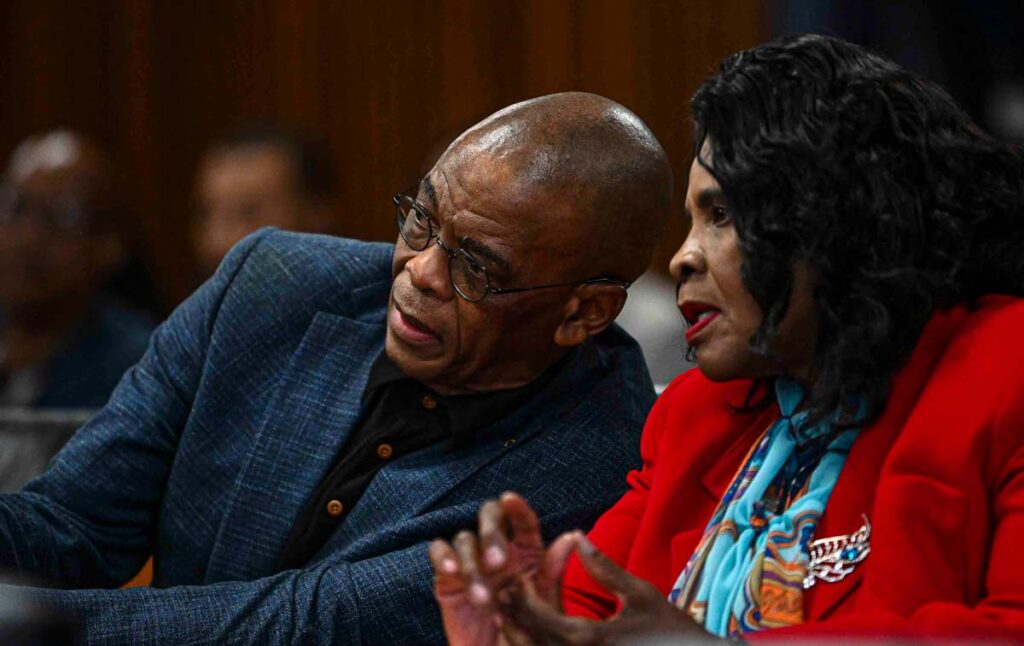
Former Free State Premier, Ace Magashule, speaks to former Mangaung Mayor, Sarah Matawana Olly Mlamleli, at Bloemfontein High Court in South Africa, in April 2025. Photo: Mlungisi Louw/Volksblad/Gallo Images via Getty Images
An investigation by News24 journalist Jeff Wicks uncovered, in detail, the corruption Deokaran sought to stop. The story even won Wicks the 2023 Taco Kuiper Prize, an important investigative journalism award in South Africa.
Though her murder became front-page news for many weeks and led to the arrest and conviction of the hitmen, the masterminds who ordered the hit and whose corruption she flagged are still free. In a thread on X, in August 2024, Wicks bemoaned the fact that the police investigation into the masterminds had gone cold.
“Today, on the third anniversary of her death, the only ones in orange are the triggermen… [The] mastermind [is] free. [The] tender vultures [are] free. This is an insult to her memory and what she stood for,” Wicks wrote.
Yet, due to the nature of South African democracy, the case is not altogether dead.
While it took a long time to suspend those implicated in the wrongdoing Deokaran flagged – some of whom might have had a hand in her murder—investigations on other fronts continued. The Special Investigating Unit (SIU), an anti-corruption, forensic investigation, and litigation agency that works for the state, has been investigating the cases Deokaran flagged, and in August 2024, valued Tembisa Hospital’s corrupt transactions at R3 billion.
Yet, even as the SIU claimed progress, News24 reported in December last year that a man whose business Deokaran flagged before her murder was still a free man and had since been awarded another fat contract by the South African Police Service – worth R360 million.
In another matter, former Free State premier Ace Magashule and his co-accused have become regular faces in South African courts. They are facing the law for having unduly benefited from an asbestos-removal contract that the Public Protector found, in a 2020 report, to have been corruptly awarded and executed.
The case has been widely covered since at least 2015 and has received the attention of all anti-corruption agencies. Though different cases remain open, not one of the corruption masterminds has been convicted.
Magashule has maintained he has no case to answer. One of his co-accused—Moroadi Cholota, his former personal assistant—wants the case dropped, too. Cholota claims fraud charges against her are unconstitutional and invalid.
It remains to be seen if this case will progress and lead to convictions soon. Judging by the pace it has taken since questions were first raised about the asbestos project in 2014, the case does not look promising.
South Africa has courts that enjoy an independence not known in many states across Africa. A corruption case might still lead to convictions and the recovery of proceeds of crime. It has happened before, albeit very slowly.
By contrast, what recourse to justice do the people of Eswatini have? The kingdom does have a press: two major dailies, state television and radio, online publications and social media. Stories of corruption abound. Citizens do care. In anger, they write long letters to the editor demanding a kind of justice: arrests, the recovery of ill-gotten gains. Something. They share their disapproval loudly on social media. And, sometimes, take to the streets to protest.
All this civic action, often triggered by the media, leads to nothing. No arrests and, by extension, no convictions. Month after month, year after year. This has been the case since 1973, when the current king’s father, King Sobhuza II, decided to rule by decree. The 2005 Constitution, which the incumbent signed into law, only entrenched the absolute nature of his rule. He is head of all three arms of government.
What role in the fight against corruption can the media possibly play in such a scenario? Only the role of noting things for researchers?

Cebelihle Mbuyisa
Cebelihle Mbuyisa is a journalist and, presently, a documentary filmmaker in training. He primarily reports on Eswatini issues; though he, on occasion, covers South Africa and Lesotho also. He was, in 2022, joint winner of the Nat Nakasa Award for Courageous Journalism.