The de facto closure of the Strait of Hormuz following the US-Israeli attack on Iran has unleashed a global fertiliser supply shock that is intensifying food insecurity in Nigeria. According to the World Food Programme, 35 million Nigerians are already facing acute food insecurity, more than 14% of the population.
Higher energy and freight costs, tighter insurance conditions and delayed fertiliser shipments are directly increasing the cost of agricultural production and pushing up food prices. The timing could hardly be worse as the disruption coincides with the beginning of Nigeria’s planting season.
Transformational investments, partial resilience
Unlike during the Covid-19 pandemic and the Ukraine war, the country faces this shock with an important advantage: domestic urea production, a main nitrogen-based fertiliser ingredient, reached record levels in 2024 (to 4.18 million metric tonnes, a 13% increase from 2023, according to the International Fertilizer Development Center). However, the buffer only provides a partial shield. Nearly all urea output is exported, leaving domestic needs underserved. Worse, what is left for the domestic market is sold at international market price.
Moreover, Nigeria still depends on imported materials for blended NPK fertilisers — potash, phosphate and granular ammonium sulphate — mostly sourced from Russia, Morocco and China (Nigeria imported 179,000 tonnes of diammonium phosphate, 191,000 tonnes of muriate of potash and 389,000 tonnes of ammonium sulphate in 2024 despite the capacity surge).
Estimates suggest that in 2024, almost one-third of global seaborne fertiliser trade passed through the Gulf, other than an estimated 20% of liquified natural gas, a key fertiliser feedstock, and 27% of globally traded oil. When those flows tighten, fertiliser prices rise regardless of domestic nitrogen capacity.
In other words, while Dangote and other domestic investments have significantly expanded national nitrogen fertiliser capacity, dependence on imported blending materials persists. Farmers remain exposed to higher prices, constrained credit and unequal access across regions.
The chain is simple: higher input costs reduce affordability, delayed shipments compress an already narrow planting window, farmers cut application rates, yields fall, and food prices climb. These cumulative effects are especially damaging as the attacks on Iran and the following trade disruptions coincided with the pre‑wet‑season purchasing and application window.
Multi-vector strains
These pressures land on a system already under strain. Insecurity across key agricultural regions continues to disrupt agricultural production and displace farming communities, while transport and warehousing gaps slow distribution. Food inflation and rising living costs have already eroded household purchasing power despite some macroeconomic improvements. The Gulf shock compounds these structural weaknesses by driving up energy and fertiliser costs simultaneously.
The adjustment will be uneven. Large commercial producers and well-capitalised traders can absorb higher costs or secure alternative supplies, but smallholders cannot. For many small farmers, fertiliser is not a tool for maximising yields but a basic condition for production.
That fall in application rates will reduce cereal yields, tighten domestic supply, and place renewed upward pressure on staple food prices. In an economy where food takes a large share of household expenditure, even modest yield declines have broad social and economic consequences.
The Strait of Hormuz disruption illustrates once more how fertiliser sits at the intersection of geopolitics, energy markets, logistics and domestic food systems. It exposes how vulnerable Nigerian food systems remain to external shocks transmitted through global fertiliser, shipping and energy markets. If the disruption persists through a full planting cycle, the effects will become far harder to absorb: lower application rates, lower yields and another round of food-price pressure that will worsen food insecurity.
Necessary pivot
Nigeria’s response needs to combine immediate crisis management with longer-term resilience building: fast-track emergency procurement of alternative cargoes and prioritise distribution to smallholders and staple-crop areas; shore up trade finance and insurance support for critical imports to prevent market paralysis; and accelerate domestic blending and storage capacity, including public-private blending facilities and transparent allocation systems, to reduce future vulnerability. The current shock also underscores the risks of excessive reliance on imported chemical inputs and strengthens the case for more resilient, sustainable farming systems.
The Strait of Hormuz disruption is yet another reminder that global instability is feeding directly into the cost of producing and accessing food in Nigeria and that domestic food systems need to become more resilient.
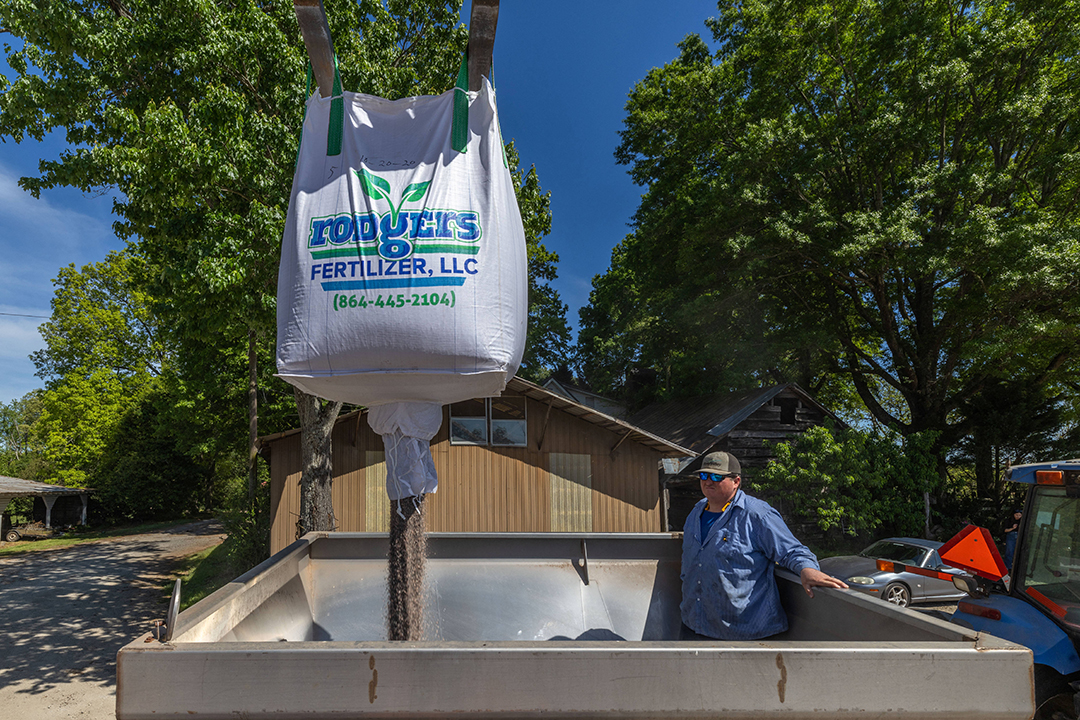
Fertiliser is loaded into machinery in preparation for spreading across Andy Corriher’s farm in China Grove, North Carolina, on April 10, 2026. US farmers are facing a double whammy of soaring fertiliser and diesel prices after US-Israeli strikes on Iran and the blockage of the Strait of Hormuz. Photo by Grant Baldwin/AFP

Dr Julia Bello-Schünemann is a multilingual research consultant. She is versed in integrated forecasting across sectors (including demographics, infrastructure, economics, conflict and violence, etc.), trend and risk analysis, data analysis, policy advice for governments and international organisations. Her expertise straddles Africa, Latin America, the Caribbean, and the European Union. She possesses vast experience in project management, fundraising, strategic planning, multi-stakeholder consultations, training and facilitation. She is currently an Associate Senior Research Consultant with Good Governance Africa-Nigeria. She holds a PhD in International Relations from the Complutense University Madrid, Spain and an MA in Communication, Political Science and Economics from Ludwig-Maximilians-University, Munich in Germany.