
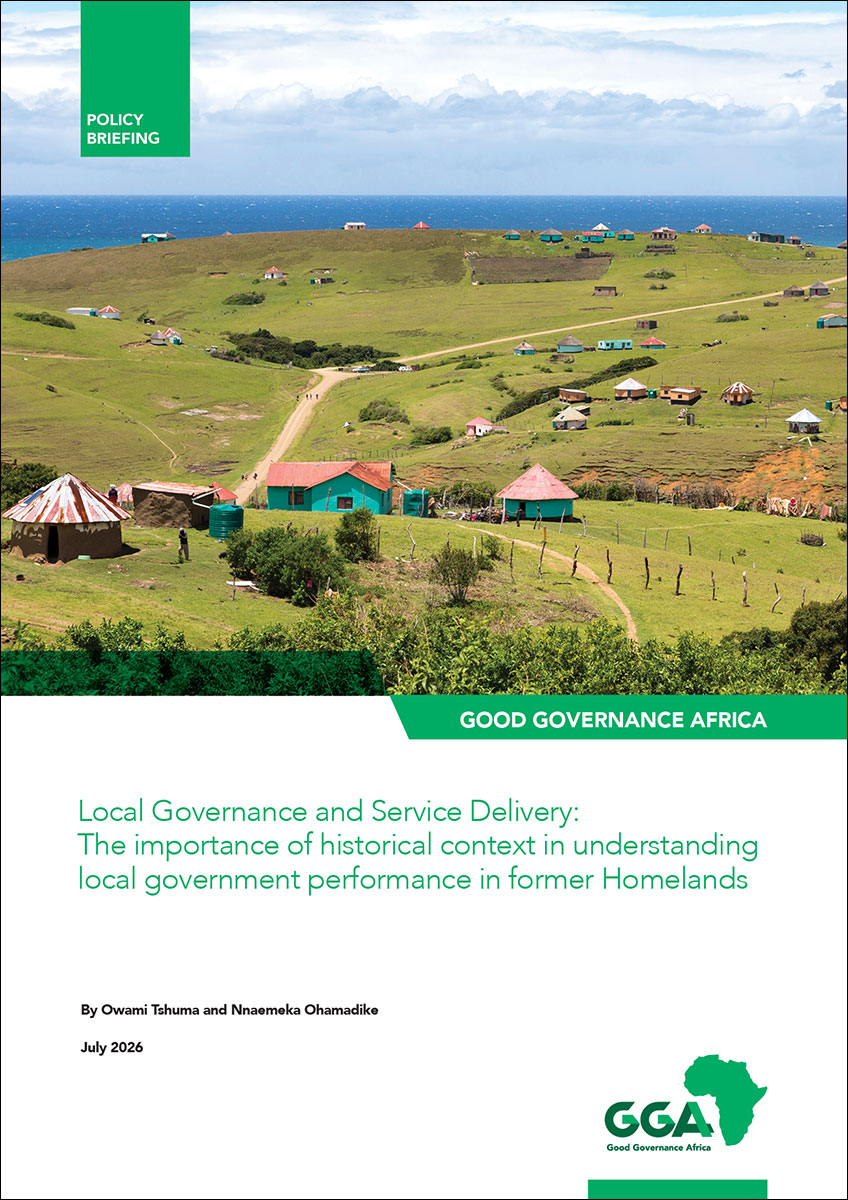
Service delivery is one of the clearest channels through which to assess whether South Africa’s municipalities are living up to their constitutional mandates. Yet access to basic services is still uneven, especially in municipalities in former Homeland and Traditional Authority (TA) areas. These municipalities continue to face the legacy of historical spatial exclusion. Many have weak local economies, infrastructure backlogs, and low institutional capacity, which limit service delivery, investment, socioeconomic opportunities and growth. This policy briefing places municipal performance gaps in their historical context and shows how data-driven tools, such as Good Governance Africa’s Governance Performance Index (GPI), can identify where service delivery and socio-economic weaknesses are most severe, where progress is being made, and how support can be targeted. The findings show that decades after the formal end of apartheid, former Homeland/TA municipalities remain concentrated in lower service-delivery rank bands and still lag behind in access to safe water, proper sanitation, and reliable waste removal services. These gaps partly mirror the historical and spatial inequalities that continue to shape citizens’ opportunities. We argue that the GPI can serve as a practical diagnostic tool for government, the private sector, civil society, and development partners to identify where municipalities are improving, where weaknesses remain, where support is most urgent, and which interventions are likely to have the greatest impact.

Owami is a junior data analyst intern in the Governance Insights and Analytics programme at Good Governance Africa. She is completing a Master’s degree in e-Science at the University of the Witwatersrand, building on a foundation in International Relations and Political Science. Her research interests focus on political economy with a particular focus on development and elections. She is especially interested in the intersection of governance, economic development, and institutional quality.

Nnaemeka served as a Senior Data Analyst at Good Governance Africa. He completed his PhD in Applied Data Science at the University of Johannesburg, South Africa, supported by South Africa’s Department of Science, Technology and Innovation. His research applies data science and computational methods to questions of governance, social bias, political attitudes, human development, and disinformation. His work has been published in journals including EPJ Data Science, Journal of Computational Social Science, Social Science Computer Review, Political Psychology, and Politeia. He has also worked as a Data Consultant at DataEQ Consulting and has teaching experience at the University of the Witwatersrand, both in South Africa.