
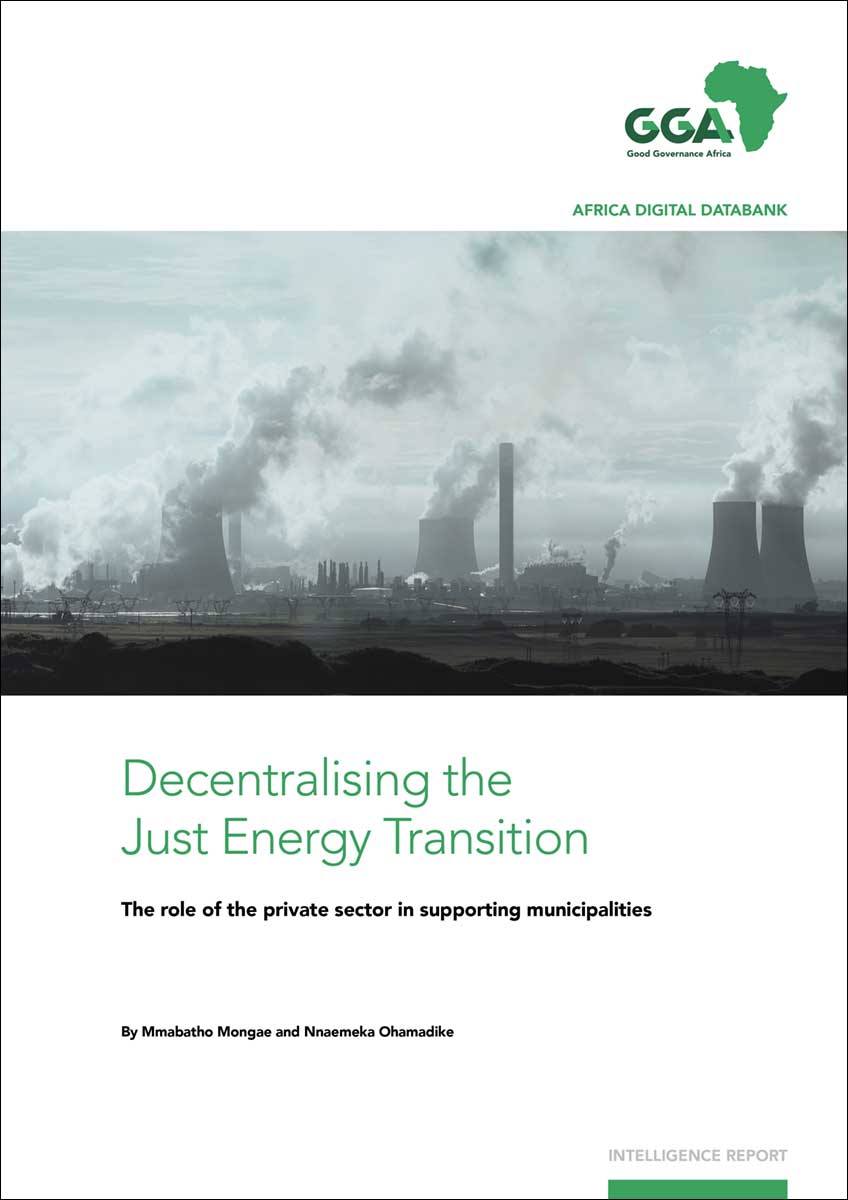
With nearly 86% of its carbon dioxide (CO2) coming from coal, South Africa is one of the world’s most coal-dependent countries. Additionally, it produces nearly a quarter of the continent’s total carbon emissions. Its economy is highly dependent on agriculture and mineral extraction, which are energy-intensive. Importantly, South Africa is subject to climate variability and change. The effects are exacerbated by dysfunctional municipalities’ limited ability to build climate resilience systems and ensure robust disaster risk management. With local government administrative instability, service delivery failures, and financial mismanagement highlighted by Good Governance Africa’s (GGA) Governance Performance Index (GPI), societal stakeholders bear the brunt of dysfunction, particularly amidst escalating climate-induced natural disasters, which further strain government resources. As such, the fight against climate change requires a coordinated response from government, the private sector, and citizens. Presently, citizens do not identify the private sector as a key stakeholder in mitigating climate change. This suggests that the private sector does not have a visible presence in the fight against climate change, thereby presenting the private sector with an opportunity to support the decentralisation of the just energy transition. These efforts can also form part of attempts by the private sector to mainstream Environmental, Social, and Corporate Governance (ESG) best practices.

Dr Mmabatho Mongae is the acting head of the Governance Insights and Analytics programme at Good Governance Africa (GGA), where she plays a key role in developing innovative, data-driven tools to improve governance and urban management across the continent. Her work includes the Governance Performance Index (GPI) and the African Cities Profiling Project, an initiative aimed at building a comprehensive information bank to assist cities in enhancing service delivery for both citizens and enterprises.
With a PhD in International Relations from the University of the Witwatersrand and as a research fellow at the Centre for Africa-China Studies, Mmabatho’s work bridges rigorous academic research with real-world policy challenges. Before joining GGA, Mmabatho lectured in International Relations at Wits University and received a 2025 M&G 200 Young South Africans award.

Nnaemeka served as a Senior Data Analyst at Good Governance Africa. He completed his PhD in Applied Data Science at the University of Johannesburg, South Africa, supported by South Africa’s Department of Science, Technology and Innovation. His research applies data science and computational methods to questions of governance, social bias, political attitudes, human development, and disinformation. His work has been published in journals including EPJ Data Science, Journal of Computational Social Science, Social Science Computer Review, Political Psychology, and Politeia. He has also worked as a Data Consultant at DataEQ Consulting and has teaching experience at the University of the Witwatersrand, both in South Africa.