
Because agriculture is Africa’s largest economic sector, generating profits of more than $100 billion annually, or 15% of the continent’s combined gross domestic product, it is also a magnet for grand corruption in rural environments heavily skewed by patriarchy.
Berlin-headquartered anti-corruption non-profit Transparency International (TI) notes that its surveys have revealed that “the institutions most responsible for land management in Africa are also among the most corrupt. Globally, one in five people reports they have paid a bribe for land services; but in Africa, every second client of land administration services paid bribes.”
The organisation also noted that its national chapters across the continent had ranked “the problem of land and political corruption as one of the top three issues that citizens consult them about through their Advocacy and Legal Advice Centres.”
Meanwhile, the Thomson Reuters Foundation’s Wealth of Nations research project estimates that Africa loses an estimated $30 to 60 million annually to illicit financial flows through “aggressive tax avoidance, corruption, smuggling, and other means”, and that in sub-Saharan Africa, this loss of revenue is equivalent to as much as 11,6% of regional trade.
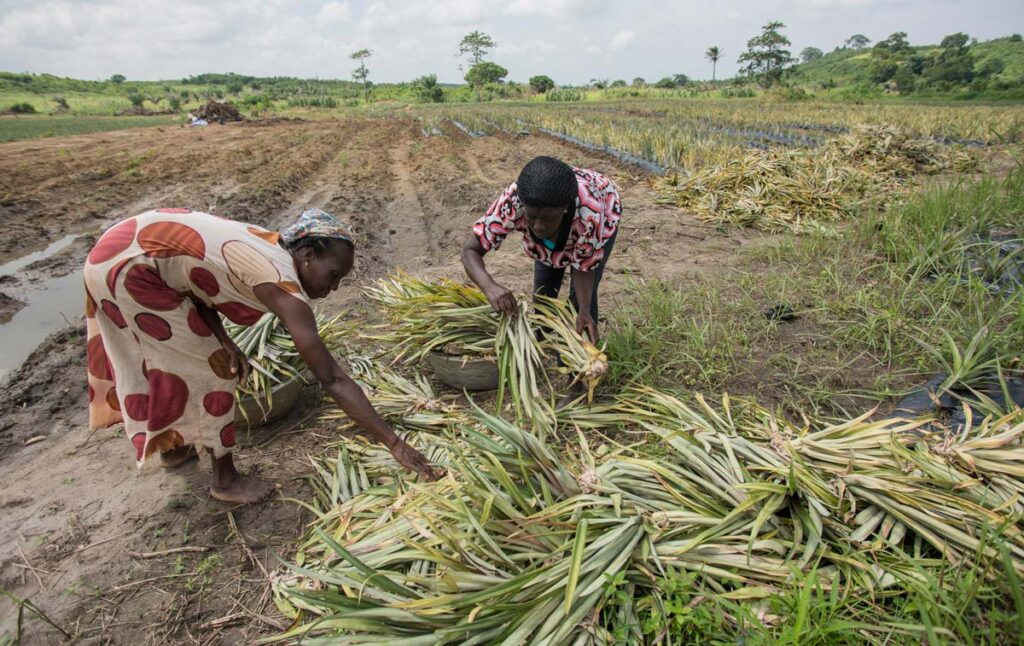
Farmers select pineapple plants according to size in Ekumfi, Ghana. Photo: Cristina Aldehuela / AFP
Much of this untaxed profit, TI states, is “stolen by multinational corporations, especially in land speculation and land-based extractives industries”, and that its scale “cripples those economies. Add to this the fact that only one per cent of land in sub-Saharan Africa is mapped adequately on a land registry, and it is clear that the land sector is wide-open for corruption.”
The organisation stressed that “land corruption also disproportionately affects women: less than 8% of women in West Africa own land and less than 30% in East Africa”, compared to an international median of less than 15%, “yet up to 70% of food is produced by women farmers”.
Most African countries have inherited a sometimes-contradictory mix of land ownership and usage traditions, laws, and regulations derived from the colonial-era clash between European private property exclusive-use principles based on measured land-mapping, or cadastre, and African communal property common-use principles based on seasonal cropping and pasturage needs. This clash is exacerbated by the debasing of traditional land allocation systems and community dispute-resolution due to corruption.
An example is Ghana, in which “customary freehold” land title was recognised in the 1992 Constitution, enabling traditional authorities to grant title to community members to land that does not conflict with communal “allodial” occupancy rights – but this has repeatedly been rejected by the National House of Chiefs. In essence, there is a gap between the formalities of western-derived law and how powers are exercised at local level by chiefs, and by traditional land administrators known as tindana.
“The denial of land title by the tindana, without consultation with the council of elders, is in violation of common law,” TI says. “But there is an increasing tendency across Ghana for these officeholders to assume absolute authority over land. Access to land has thus come to hinge on the ability of both men and women to provide incentives for the tindana to act in their favour.”
Traditionally, a token gift of a kola nut would secure an audience with a chief or tindana who could rule on land matters, but this has been modernised into a gift of “drink-money”, and increasingly, the tribal authorities simply rule in disputes in favour of whoever pays them more.
TI says that “women face systemic violation of their rights to security of tenure and equal participation in decision-making. In her paternal home, the woman must obtain her father’s permission to access familial land. In the marital home, this access is mediated by her husband or father-in-law.”
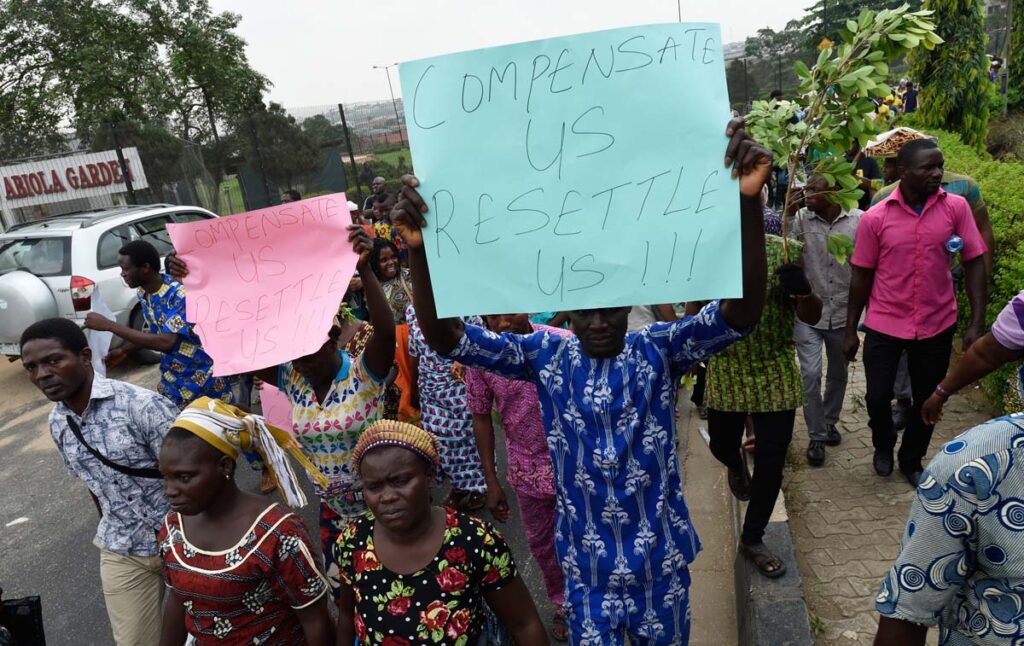
Evictees of Lagos shanty town Otodo-Gbame march to demand relief and resettlement in November 2017. Photo: Pius Utomi Ekpei / AFP
Corruption in land affairs is not only fallout from the clash of traditionalism and modernism, however, but often involves shady foreign investors, as in Tanzania, where all land is vested in trust in the office of the president, who acts as custodian. During Tanzania’s transition from a socialist to a capitalist state in 1999, the Land Act was passed, allowing anyone wanting to occupy land to apply for a 33- to 99-year “right of occupancy”. This system of occupancy yet not ownership is common throughout sub-Saharan Africa.
Also in 1999, the Village Land Act was passed, recognising customary land rights within the vicinity of villages, and allows for certain human activities such as farming and grazing within wildlife corridors called Game Controlled Areas (GCAs) – but it did not recognise the land-usage rights of roving pastoralists and hunter-gatherers such as the Maasai tribe.
The Maasai live primarily in Loliondo, a GCA corridor between the Serengeti National Park, from which the British expelled them a century ago when the park was created, and the Ngorongoro Crater tourist attraction.
In 1992, the Tanzanian government under then-President Ali Hassan Mwinyi leased 4,000 km² of Maasai land in the Loliondo GCA to the deputy defence minister of the United Arab Emirates (UAE), Brigadier Mohammed Abdulrahim al-Ali, giving a 10-year hunting concession to the Otterlo Business Corporation, a UAE company linked to al-Ali, to hunt a limited number of non-endangered species.
There are eight Maasai villages within the concessionary area, and the Maasai refused to endorse the lease agreement, as was their legal right, but the MP for Ngorongoro, Richard Koillah, illegally signed the agreement “on behalf of” six of the villages.
Otterlo established a luxury hunting resort on 1,500 km² of the leased village land, TI noted. “Reports soon emerged that the corporation was exceeding its quota of big cats and antelope, and engaging in illegal hunting activities, including the use of automatic weapons, baits, fire-setting (to herd animals), as well as hunting from vehicles.
“Regular conflicts with the local community over access to grazing land and vital water sources have frequently resulted in violent clashes, within or near the core hunting area… The conflicts with local Maasai communities, and the wide-ranging impact of losing vital grazing lands and water sources have been well documented by local activists, NGOs and by international media,” TI reported. In July 2016, local police and Tanzania National Parks Authority rangers conducted a series of raids on Maasai villages in Loliondo, and four local activists working on the case were arrested for “espionage and sabotage”.

Members of the Maa unity agenda, take part in a protest in Nairobi, condemning the forceful eviction of the Loliondo Ngorongoro Maa community, in June 2022. Photo: Tony Karumba / AFP
But the government’s illegal and violent suppression of the Maasai to protect a lawless foreign corporation drew international condemnation, and in November 2017, the newly appointed Minister for Natural Resources, Hamisi Kigwangalla, ordered the arrest of Otterlo’s executive director on corruption charges, and announced corruption investigations into former ministers. Otterlo’s hunting licence was cancelled and the director of wildlife suspended for “creating a syndicate of government officials in the ministry who have been compromised”.
Yet the struggle was far from over. On 25 May 2022, the Maasai community submitted a report to the government on what it believed was the best way to resolve the dispute by balancing wildlife conservation and pasturage. The government, however, simply ignored the report and deployed more forces to Londiolo; in June, clashes between Maasai and police left scores injured and one policeman dead.
In October that year, the East African court ruled in favour of the Tanzanian government on the grounds of lack of sufficient evidence provided by the plaintiffs, so the Maasai lodged an appeal shortly after with the Appellate Division that is still to be heard.
Land theft enabled by authorities corrupted by developers increasingly occurs in urban areas too and usually involves speculators engaging in illegal evictions of poor communities under the guise of “slum clearance” for reasons of public health and sanitation, and for fighting crime, to erect high-rent developments for the wealthy.
This occurred on the 80 km-long Lekki Peninsula of Lagos in Nigeria, where on 9 October 2016, Lagos State Governor Akinwunmi Ambode announced a plan to demolish waterfront fishing villages, including Otodo Gbame, allegedly to curb criminality. On 31 October, the Lagos State House Assembly passed a resolution calling on Ambode to halt the demolition plans, and on 7 November the Lagos State High Court granted an interim injunction preventing the state government from proceeding with the demolition of informal settlements along the waterfronts, including Otodo Gbame.
Yet the demolitions went ahead on Ambode’s instruction, as Amnesty International confirmed, during which vigilantes aided by local police and Lagos State Building Agency agents burnt Otodo Gbame to the ground, displacing 30,000 people. TI calls this practice “military urbanism… the practice of securing advantage through violent targeting of urban spaces in the contest for wealth and power.”
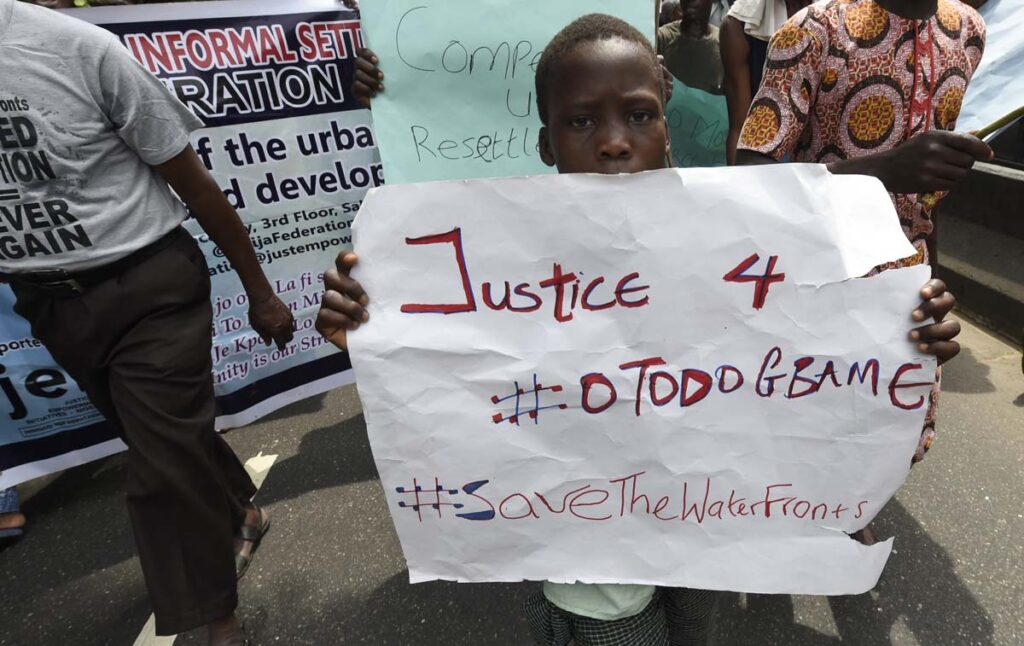
A young boy holds a sign as he and other evictees of Otodo-Gbame, a Lagos shanty town, march to press for relief and resettlement in Lagos, in November 2017. Photo: Pius Utomi Ekpei / AFP
The organisation says that, invariably, such gross human rights violations are justified on grounds of development and public health and safety, yet the seized lands are not turned into formal housing projects for the broader populace, but into exclusive enclaves for the wealthy.
The local press completely distorted the narrative, and, TI stressed, ignored the fact that Saheed Elegushi, the oba (chief) of the neighbouring Ikate kingdom and a close friend of Ambode, was also a real-estate developer who was using his influence to expand his kingdom at the expense of his poor neighbours by integrating it into the Lekki Master Plan.
This would see part of his kingdom transformed into the Imperial International Business City on Lekki Peninsula as an extremely lucrative free trade zone within a new city planned to accommodate 3.4-million residents and 1.9-million commuters.
The illegal demolition of Otodo Gbame and several other fishing villages occurred in violation of laws that provide that communities can argue against such demolitions at urban and regional planning tribunals, and for paid relocation and adequate compensation should they agree.
“The first evictions to modernise Lagos date back to the dictatorship of General Ibrahim Babangida,” TI notes. “In July 1990, the former Military Administrator of Lagos (Colonel Raji Rasaki) ordered bulldozers to move in and raze Maroko, a large waterfront community on Victoria Island… More than 300,000 people lost their homes.”
The African Commission on Human and Peoples’ Rights ruled that the evictees should be compensated, but Nigeria ignored the ruling. African courts need to be given enforcement agencies to ensure their judgments cannot simply be brushed aside by corrupt state officials.
And as Africa enters the most intense phase of new city construction and tourism development in its history, international sanctions, including criminal prosecutions, need to be applied against the finance houses and development firms, mostly foreign, which corrupt local elites to facilitate urban and rural land-theft.

Michael Schmidt is a veteran investigative journalist who focuses on African affairs, a best-selling non-fiction author, and a human rights rapporteur with field experience in 49 countries. He has reported from the bowels of many corporate and artisinal mines, and writes here in his capacity as an analyst for the Pan-African Justice Initiative (PAJI).