Burkina Faso’s military officer-come-political-leader, Captain Ibrahim Traoré, came to power in September 2022, after leading the country’s seventh military coup since independence in 1960. Traoré ousted Lt Col Paul Henri Damiba, the leader of the country’s previous coup in the same year. With Traoré’s support, Damiba ousted the country’s civilian president, Roch Marc Christian Kaboré.
Traoré has grown in popularity at home and across the continent since coming to power. In Kenya, he’s become a symbol of “hope and inspiration”, while at the inauguration of Ghana’s President John Mahama earlier this year, he received the loudest applause of the 21 African heads of state in attendance.
The celebration of and hope placed in Traoré, by Burkinabé and Africans elsewhere on the continent and in the diaspora, though understandable, is misguided. It’s as misguided as many of the social media products praising Traoré aren’t real.
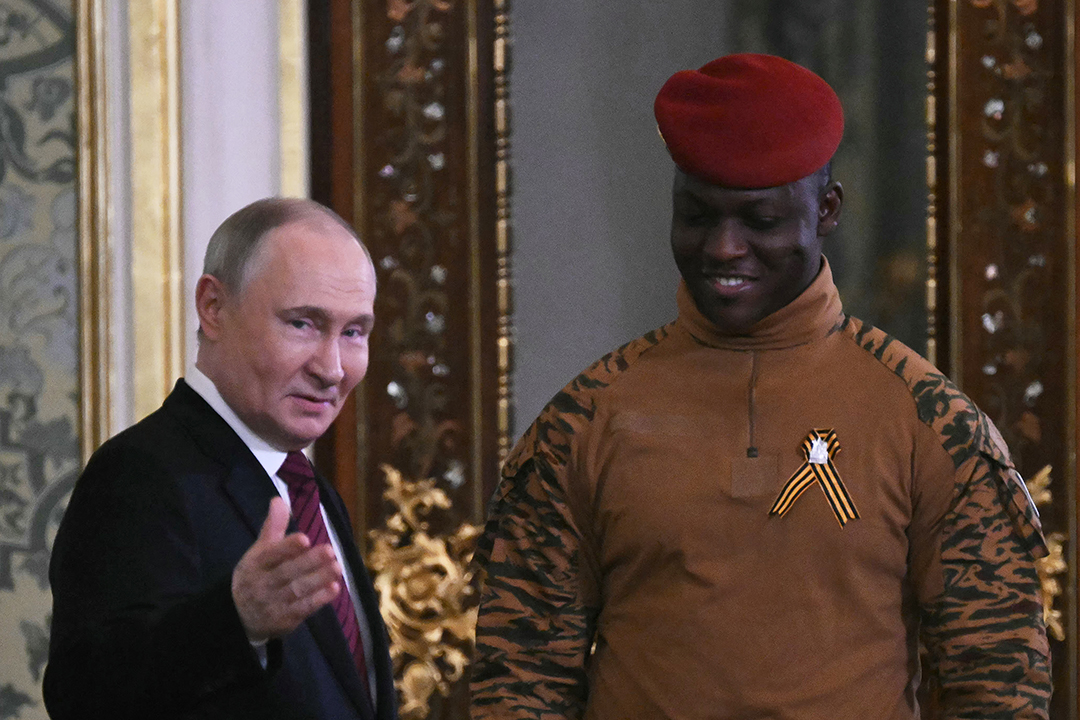
Russia’s President Vladimir Putin (L) and Burkina Faso’s junta leader Captain Ibrahim Traore (R) arrive for their talks in Moscow on May 10, 2025, during celebrations of the 80th anniversary of the Soviet Union’s victory over Nazi Germany in World War II. (Photo by Angelos Tzortzinis / AFP)
This essay is divided, firstly, into reasons why support for “The People’s Captain” is understandable and, secondly, reasons why supporting Traoré is misguided.
Support for Traoré is understandable, firstly because the demand for good political leadership in Africa outstrips supply. In a continent desperate for virtuous and effective political leadership, leaders perceived as good and offering hope can quickly garner significant support. Secondly, people might perceive the military, and by implication its leaders, as the solution to the rising violent religious extremism (VRE) gripping Burkina Faso and other African countries. Thirdly, Africa’s youth are marginalised and losing faith in democracy, making it easier to support undemocratic or authoritarian leaders. A final reason, related to the third, is that democracy is misunderstood, making it easier for people to perceive democracy as having failed when, in fact, it’s governments that claim to be democratic but aren’t, which have failed.
Support for Traoré is misguided because he represents the military rule of a country, something the military isn’t designed for, making it ill-equipped for such a task. Also, colonialism has made for a mostly negative history of civil-military relations in Africa, a history bound to repeat itself in Burkina Faso, if it hasn’t already begun to do so. Under Traoré’s leadership, Burkina Faso’s security has deteriorated, contrary to what he and the military committed to when they toppled the civilian government. Civic space has decreased, while human rights violations have increased since Traoré came to power. Finally, whether the new foreign actors with whom Traoré has aligned Burkina Faso are any better than the old is highly questionable.
Why support for ‘The People’s Captain’ is understandable
There are several related reasons why Burkinabé and Africans elsewhere would have celebrated Traoré’s accession to power, the failure of the latest among several coup attempts against him, and why there is support for his ongoing leadership, including in the face of Western criticism.
In Africa, demand for good political leadership outstrips supply
Africa’s immediate post-colonial civilian political leaders inherited the extractive governance structures that European political leadership established. However, rather than dismantling these structures or transforming them in the national interest, many of these civilian governors and their successors adapted them for narrow ethnic and/or elite interests. Burkina Faso is a case in point.
James Robinson’s thesis about elite formation and reproduction and Jeffrey Herbst’s views on the African state-building process help contextualise the consistencies in political leadership that have and continue to harm Africa and its people.
According to Fahiraman Koné and Ornella Moderan, writing after the 2022 military coup against Burkina Faso’s most recent civilian president:
“Many Burkinabè were…frustrated with the political management of the Kaboré regime, which was regularly accused of corruption, laxity and nepotism. Since 2017, polls have shown a steady decline in trust and satisfaction with a government that has failed to meet the Burkinabè people’s expectations for good governance. These expectations were considerable after 27 years of rule by [Blaise] Compaoré, who also came to power in a coup.”
Indeed, African citizens have mostly been deprived of competent, people-centred political leadership. In a continent where this kind of leadership is hard to come by or limited because of loyalties fixed on narrow conceptualisations of identity, the desperation for good political leadership remains high.
This is why, according to Afrobarometer findings published in 2024, “More than half of Africans (53% across 39 countries) are willing to accept a military takeover if elected leaders ‘abuse power for their own ends.” In Burkina Faso specifically, opposition to military rule has weakened substantially compared to other African countries.
The willingness to accept military rule doesn’t deny that “Africans want more democracy”. However, Africa’s citizens are increasingly willing to sacrifice failed civilian governments, including those that came to power through democratic elections, for military rule, especially if the military is perceived as able to deliver the material dividends that civilian political leaders can’t.
The willingness to accept a military takeover varies according to region, with the highest support for military rule in the Sahel.
In the context of Africa’s post-colonial political leadership, whatever good Traoré has done (real or perceived), or whatever developmental progress Burkina Faso has made during his relatively short time in power (see reports here, here, and here for example), Africans inside and beyond Burkina Faso have been given hope – and hope is a powerful motivator of political behaviour, no matter how misplaced it may be.
Ultimately, a country’s long-term, sustainable economic growth and development are predicated on a stable and predictable political system. So, unless Traoré brings about major reforms to ensure this outcome, his initiatives will go nowhere and simply serve as performative.
The rise in violent religious extremism and the perceived role of the military
In 2024, Africa was designated “the new global terrorism epicentre” – a designation retained in 2025.
This year, six African countries occupy the top 10 rankings of the Global Terrorism Index (GTI). Burkina Faso occupies the top spot, having ranked in the top 10 annually since 2020. Ranked 15th in the 2019 GTI, Burkina Faso was ranked 7th in 2020, 6th in 2021, 4th in 2022, 2nd in 2023, and 1st in both 2024 and 2025.
In early 2022, before Traoré came to power, the ISS reported the following about Burkina Faso:
“Since 2015, the country has faced an unprecedented crisis that has killed an estimated 7,569 people in six years and displaced more than 1.6 million. Frequent attacks by jihadist insurgents have targeted civilians and government officials, especially the armed forces, which have suffered heavy losses. Teachers, civil servants and judicial staff are also being targeted, leading to the disuse of public services in conflict-affected areas.”
For several years, Burkina Faso has also been featured annually on the Open Doors World Watch List (WWL), which ranks the 50 countries where Christians experience the most persecution, including VRE. In the 2025 WWL, Open Doors cites “Islamic oppression”, including violent forms, among the main threats confronting the country’s minority Christian population.
Considering Burkina Faso recorded zero deaths from terror attacks in 2014, the country has experienced an exponential rise in terrorist activity. The fast-paced deterioration of Burkina Faso’s security cannot be separated from the broader regional security context in which the country has found itself. Conflict spillover from Mali and the failure of multiple peace operations in the region are among the factors that have shaped and continue to shape this context.
One of the expectations of political leadership in Burkina Faso and other African countries plagued by terrorism and one of its sub-sets, VRE, is the prevention and countering of these forms of violence, for which political leadership is responsible to some or a large degree.
It’s understandable why, under such conditions, citizens who view the military as a disciplined, hierarchical organisation that can establish order where there is perceived to be little or none celebrate the installation of military governments and deprioritise constitutionalism in favour of physical security, without which the value of civil and political rights becomes questionable.
The loud applause that Traoré received during Mahama’s inauguration in Ghana was symbolic of Africans’ trust in the military, which is routinely found to be higher than trust in any other state institution, and the acceptance in Africa of the military as a force driving or making political decisions. Over recent years, the increase in VRE in different parts of the continent may have reinforced this view.
The increase and extent of VRE in Burkina Faso is one reason why, during celebrations in the country’s capital, Ouagadougou, that followed Traoré’s ousting of Damiba, one young resident said, “We want change, truly fundamental change, a change that will bring peace to Burkina Faso. Even if it takes 10 coups, we will find the right solution.”
The claim that the Burkinabé state was failing to provide physical security for its citizens and secure the integrity of its territory (the raison d’être of any state) was the reason Damiba and Traoré overthrew their respective civilian and military predecessors.
Africa’s youth are marginalised and losing faith in democracy
Africa has the youngest population in the world. According to the World Economic Forum (WEF), more than 60% of Africa’s population was under 25 in 2022. Today, the African Union (AU) reports that more than a quarter of the continent’s population is aged 15 to 35. By 2030, “young people in Africa are projected to make up 42% of the global youth”.
According to the Ecological Threat Report 2024, “A large increase in the youthful percentage of a population is known as a ‘youth bulge’.” The Institute for Economics and Peace reports, “A larger youth bulge is associated with an elevated likelihood of conflict and heightened political activism among the youth.” This is why the International Labour Organisation’s (ILO) Global Employment Trends for Youth 2024 report warns of an African “youthquake”.
Several challenges confront Africa’s youth. In some respects, these affect youth across the continent, and in others, they are more country-specific. The challenges, all of which have characterised Burkina Faso to one degree or another, include, but are not limited to, a lack of access to education, unemployment, exclusion from participation in formal politics, and the risk of voluntary or forced recruitment to VRE groups.
Many youth experience these challenges under the leadership of substantially older civilian political leaders and heads of state. These leaders, despite portraying their countries as democratic, are inclined to subvert democratic institutions for undemocratic and nefarious ends. Examples include election rigging, extending term limits, and using the legislature and judiciary to advance political party and/or factional interests to the detriment of the collective good.
The existence of this political leadership culture on a continental level is illustrated by the fact that by 2018, only one country had submitted a report on compliance with the African Charter on Democracy, Elections and Governance since it became legally binding for AU state parties in 2012.
Consider the implications for what African youth think of democracy and how they view a confident, charismatic military coup leader who was 34 years old at the time of his takeover and portrays himself as a pan-Africanist fighting neocolonialism.
An Open Society Barometer report published in 2023 found that “young people around the world hold the least faith in democracy of any age group.” Two years earlier, Afrobarometer reported that “African youth are less likely to vote, participate in community meetings, or contact political leaders compared to those over the age of 35.”
For Patrick Adu, of the West Africa Civil Society Institute (WACSI), “The youth’s frustrations, if left unaddressed, could lead to a greater acceptance of authoritarian practices under the guise of strong leadership.”
Human rights campaigner Makmid Kamara writes about “youthlash”, something he defines as “the deep-seated and adverse reaction of the youthful population against current models of democracy.” According to Kamara, youthlash manifests in Africa in at least two ways: “Firstly, through a general reluctance to engage with politics or political processes associated with democracy and, secondly, through direct violence or support for violent actions undertaken by others.”
Afrobarometer’s findings that Africa’s youth “express a greater willingness to tolerate military intervention” correspond with the notion of youth lash. In Burkina Faso specifically, Afrobarometer has found that “opposition to military rule has weakened…dramatically.”
Traoré is, and looks, comparatively young. Earlier this year, the ISS reported that, “At 36, Burkina Faso’s Captain Ibrahim Traoré is the world’s youngest president – in stark contrast to Africa’s average leader age of 63.”
He holds the rank of captain and continues to dress in military fatigues (listen to what this social media influencer has to say). If only for these reasons, he is rightly or wrongly compared to Thomas Sankara, a Burkinabé hopeful from an earlier era. Could these factors contribute to his acclaim among Africa’s youth and explain why other coup leaders on the continent, including Traoré’s partners in the Alliance of Sahel States, aren’t the subjects of digital cults?
Democracy is misunderstood
Kenyan lawyer and activist Prof Patrick Lumumba has questioned the meaning of democracy and said, “We must interrogate this thing”.
Consider, for example, how political analyst Mordecai Gisanura confuses what he calls “the western conception of democracy [that] was imposed on Africa” with suppression, puppet leadership, tribalism, religious fundamentalism, and armed conflict. Gisanura happens to be from Uganda – a country whose president calls the most democratic in the world, despite it consistently achieving poor scores on Freedom House rankings and exhibiting a disconnect between citizens’ demand for democracy and the government’s ability to supply it.
On the other hand, Al Jazeera columnist Tafi Mhaka argues that, “Today, the West is not imposing democracy on unwilling African nations. It is Africans themselves who long for true democracy on the continent.”
Dr Mmabatho Mongae of Good Governance Africa highlights the importance of language in coming to terms with what people think about democracy and why. She distinguishes between electoral democracy and substantive freedom, the latter resulting from leadership that sincerely pursues democracy institutionally and behaviourally.
Dr George Mbara and Prof Suzanne Graham describe the African context as one where “democratic elections serve as the primary standard of [democratic] legitimacy.”
To the degree citizens in a country equate democracy with elections and nothing more, and experience the kind of leadership that Burkina Faso’s democratically elected civilian president Kaboré exercised, one will find celebration instead of resistance in the face of military intervention in politics.
For democracy to take root and advance in any country, power holders at different levels of society, including soldiers across military ranks, must allow it to take root and advance. In other words:
- Elected civilian office bearers must be willing to govern democratically and must be held lawfully accountable if they don’t;
- Citizens must be allowed to choose their civilian political leaders through free and fair elections;
- There must be a selection of democratic (honest, ethical, inclusive, service-oriented, and competent) leaders that citizens can choose from; and
- The national culture (and the education system that helps shape it) must allow for the development of such individuals who aspire to political leadership.
Burkina Faso was colonised for more than 120 years and formally independent for nearly 65 years. During this time, it has experienced seven “successful” military coups and an even higher frequency of failed attempts.
Unsurprisingly, in a country like this, there is precious little opportunity for democracy to be understood and/or supported, but this isn’t sufficient reason to succumb to a perpetual coup cycle.
Why support for ‘The People’s Captain’ is misguided
Traoré supported a military coup against a democratically elected president and subsequently led a coup within a coup, in both instances violating the AU’s Accra Declaration on unconstitutional changes of government in Africa. That said, the nature of the military organisation and, by implication, military rule, are more fundamental reasons why support for Traoré is misguided.
The nature of the military organisation
From a democratic and professional military perspective, the military ought to be equipped for warfare or, put differently, defending a country and its people against external (and in Africa, internal) aggression. This capacity is a substantial part of what ensures the state has a monopoly over the use of force.
For this reason, while a military’s respect for and willingness to support democracy is crucial for advancing democracy in a society, the military itself must remain an authoritarian, hierarchical, uniform, and therefore undemocratic organisation. Importantly, this is not the same as saying the military must not be a thinking, adaptive, and ethical organisation.
Because the military is a warfare organisation – one that is characterised by centralised command, a hierarchical structure, uniformity, and the devotion of resources (time, personnel and otherwise) to preparing for armed conflict – it cannot and, therefore, should not try to fulfil the duties and obligations of a civilian-constituted government.
Based on the evidence of what happens when militaries do govern states, Prof Patrick McGowan has written that, “Military rule is by definition authoritarian and is often very corrupt…and the historical record shows that military rulers govern no better than elected civilians in Africa, often much worse.” Similarly, Prof Nic Cheeseman has written about “The terrible record of military rule in Africa”. In late 2023, he argued that the bad news for Burkina Faso and other coup countries is “that recent coups are only likely to deepen their problems”.
Africa’s colonial legacy and its impact on civil-military relations
Colonialism’s effect on Africa’s civil-military relations aggravates the negative consequences of military rule in Africa that stem from the nature of the military organisation.
As it did with Africa’s political leadership, colonialism helped corrupt the role of the African military in state affairs. Instead of developing into a people-centred, service-oriented, outward-looking security organisation, many post-colonial African militaries formed part of the extractive (and oppressive) apparatus that their post-colonial civilian political leaders adopted and transformed for the latter’s own ends. Consider, for example, the role of Zimbabwe’s military in the exploitation of that country’s diamond sector, and more recently, the alleged exploitation of the vast mineral deposits by the Rwandan Defence Force in the eastern DRC.
This is why Dr Naila Salihu of the Kofi Annan International Peacekeeping Training Centre (KAIPTC) observes, “The military…remains a very strong [domestic] political actor in the [African] region.”
Burkina Faso’s worsening security situation
The military groups that Damiba and Traoré led cited the failure of the governments they overthrew to manage Burkina Faso’s jihadist insurgency as motives for their coups and claimed they would improve their country’s security situation. Traoré pledged to improve Burkina Faso’s security within “two to three months”.
However, rather than improving under the leadership of uniformed men, most recently Traoré’, Burkina Faso’s security has worsened, according to several reports, including those published by the Africa Center for Strategic Studies, the ISS, Transparency International, the Council on Foreign Relations, and, most recently, the International Crisis Group.
Comparing the research findings of Open Doors and the Institute for Economics and Peace across several years shows that religious persecution and terrorism increased in Burkina Faso following the coups of 2022, fulfilling Cheeseman’s prediction that recent coups in Burkina Faso and other countries would make things worse.
On the Open Doors WWL, Burkina Faso jumped from 32 in 2021 and 2022, to 23 in 2023, and 20 in 2024 and 2025. I have already cited the country’s rapid climb in rankings on the GTI.
Why would a country governed by an organisation specialising in security experience a decline in security? Aside from reasons like poor leadership, poor training, and corruption, there are at least two explanations for this.
First, an organisation that busies itself with matters outside its expertise is likely to experience an overall decline in its performance, including and perhaps especially in that area where, ordinarily, it is expected to perform well.
While such a scenario for the military is possible under a civilian government, its risk increases substantially when the military is the government. Therefore, focusing specifically on counter-terrorism, scholars Kiyani, Pickering, and Webb contend that:
“[P]ublic conflict between the civilian and the military leadership in a country, and declining civil control over the armed forces [or no civil control, as in the case of Burkina Faso], may often precipitate a rise in domestic terror events. Civil-military conflict and reduced civilian control can lead to agency slack by the armed forces and ineffective counter-terror policies.”
Second, evidence shows that prioritising or using only a militarised or “hard security” approach to prevent and counter VRE, or terrorism more broadly, is counterproductive. Due to the nature of a military organisation, one shouldn’t be surprised to find a military government taking such an approach to VRE.
Prof Michele Grossman, Prof Cheryl Hendricks, and Patrick Hajayandi are also among a growing number of scholars who have cautioned against over-reliance on a “hard security” approach to preventing and countering violent (religious) extremism and terrorism.
There are several causes of terrorism, some of which the military isn’t equipped to help resolve. Perhaps more importantly, African militaries (like militaries elsewhere in the world) have been known to engage in counter-terrorism in a manner that encourages the very thing they are meant to deter.
Citing the Armed Conflict Location & Event Data Project (ACLED), the ISS has reported that “security forces caused more civilian fatalities in…Burkina Faso in 2020 than violent extremist groups or communal violence”, thereby “fuelling terrorists’ propaganda”.
For example, what might be the impact of the accidental drone strikes against civilians on Nigeria’s fight against VRE?
According to a UNDP report, Journey to Extremism in Africa: Pathways to Recruitment and Disengagement, “a government action or the killing or arrest of a friend or family member” is the most common tipping point for voluntary recruitment to a terrorist group.
On the other hand, three Nigerian scholars, Ezeanyika, Ibekwe, and Adigwe, have conducted research that shows a “soft power” or non-kinetic approach to countering terrorism, which includes community engagement, economic empowerment, and counter-radicalisation efforts, was effective “in reducing recruitment, building community resilience, and fostering socioeconomic development” in Niger, Mali, and Nigeria.
Thirdly, especially after Burkina Faso’s withdrawal from ECOWAS, the country’s capacity for regional collaboration is questionable. Regional security collaboration is essential because of the transnational nature of the security threats that Burkina Faso and other countries in the region face.
The fact that Burkina Faso’s government is a military junta is significant because democracies are generally better at collaborating to create stable and effective regional blocs that can advance shared objectives.
Considering the reality of the ongoing and increasing security threats in Burkina Faso, how sustainable is the developmental progress the country has experienced under Traoré’s leadership?
Broken promises, shrinking civic space, and increasing human rights violations
Traoré and his supporters appear to have fallen into the trap of Big Man rule, resulting in a shrinking civic space while human rights violations are on the rise.
‘Big Man’ rule is “a form of autocratic governance that is highly personalised and restrained little by institutions such as an independent judiciary, elected representatives, a free press or civil society organisations.”
Boniface Dulani and John Tengatenga describe Africa’s Big Man rulers as having “appropriated and embraced many of the personalistic traits of their predecessors”. According to these scholars, “This is demonstrated, among others, by leaders who seek to circumvent the new constitutional rules to prolong their hold on power.”
According to the Africa Defense Forum (ADF), “Coup leaders and the Big Man find ways to remain in power at all costs. They often use dubious claims of insecurity and election fraud as a means of staying in power. But the longer their grip on power lasts, the more likely they are to become isolated and prone to bad decisions.”
In addition to Big Man rule being an outgrowth of Africa’s colonial legacy, ‘Great man’ theories or thinking can also motivate and drive Big Man rule. Leadership expert Peter Northouse writes:
“In the early 20th century, leadership traits were studied to determine what made certain people great leaders. The theories that were developed were called ‘great man’ theories because they focused on identifying the innate qualities and characteristics possessed by great social, political, and military leaders (e.g., Catherine the Great, Mohandas Gandhi, Indira Gandhi, Abraham Lincoln, Joan of Arc, and Napoleon Bonaparte). It was believed that people were born with these traits, and that only the ‘great’ people possessed them.”
Prof Jo-Ansie van Wyk writes about a concept similar to the Big Man rule that emerged during the 1960s, namely, “leaderism”. This refers to “leaders who set themselves up as the champions of the people and ‘leaders behaving like sergeant majors, frequently reminding the people of the need for silence in the ranks’.”
Referring to Traoré, and relying on Africa’s historical record, perhaps euphemistically concerning Jerry Rawlings, Enoch Aikins of the ISS has warned about “revolutionary leaders”:
“This is not the first time such a charismatic figure has emerged on Africa’s political scene. Many revolutionary leaders started the same way, but later deviated from the course as they clung to power. In Ghana, 32-year-old Jerry Rawlings, nicknamed ‘Junior Jesus’, emerged in late 1979 in a bloody revolution to fight corruption and sanitise the country’s political system. But after 19 years in power, his legacy was mixed.”
When Traoré and his men announced their takeover, they reassured the international community that “Burkina Faso would continue to respect its international commitments, including human rights.” Furthermore, in a Transitional Charter adopted in October 2022, the month after the coup, Traoré committed to restoring civilian government by 1 July 2024. However, in a revised charter, Traoré signed in May 2024, he extended military rule by five years and set new criteria for membership of Burkina Faso’s national assembly, namely “patriotism”.
The Africa Center for Strategic Studies has concluded from its research that “Term limit evasions are at the root of a host of governance dysfunctions in Africa and are linked to higher levels of autocracy, corruption, conflict, and propensity for coups.”
Although extending military rule and postponing elections isn’t the same as evading presidential term limits, it involves extending a leader’s time in office. One must wonder whether Burkinabés will protest further extensions of military rule, as they protested the extension of presidential term limits in 2014.
Contrary to the reassurances made immediately after the coup about upholding human rights, Burkina Faso’s human rights record has worsened under the military government. It appears violence has become the language of transformation.
Along with an elevated ranking on the Open Doors WWL, Burkina Faso’s Freedom House scores have deteriorated since the military coups of 2022. From 2021 through 2025, Freedom House scored the access that Burkinabés have to political rights and civil liberties as follows:
- 2021: 54/100 (partly free)
- 2022: 53/100 (partly free)
- 2023: 30/100 (partly free)
- 2024: 27/100 (not free)
- 2025: 25/100 (not free)
In May 2024, UN High Commissioner for Human Rights Volker Türk expressed serious concern at the…”rise in killings of civilians across Burkina Faso, with allegations of responsibility pointing to both armed groups and State actors”.
Amnesty International and Human Rights Watch are among the organisations that have reported on human rights violations in Burkina Faso under the leadership of the military government and at the hands of state security forces. Among these are arbitrary detention, the suspension of media outlets, military conscription (including of journalists who dare to criticise or question the military regime), and massacres.
In an interview with civil organisation Global Alliance Civicus, Executive Secretary and Coordinator at Balai Citoyen (a Burkinabécivil society organisation), Ousmane Lankoandé said:
“Since the rise of the military to power in January 2022, there has been a clear deterioration in human rights and civic freedoms, a phenomenon that became even more marked following the second coup in September 2022. Any voice of dissent from the official line of the military regime is systematically repressed.”
Are Burkina Faso’s new foreign partners any better?
Finally, when assessing the reasonable judgment of Traoré’s supporters, who, in their defence, are up against domestic and foreign disinformation campaigns, one must ask whether Burkina Faso’s new foreign allies are any better than the old.
There is no denying that the colonialism and the neo-colonialism that Ghana’s first independence prime minister and president, Kwame Nkrumah, warned about, have and continue to frustrate Africa’s development. In other words, foreign actors play a role in determining the likelihood of democratic success.
However, this truth doesn’t negate two further, related truths: firstly, the role that Africa’s gatekeeper political leaders have played in maintaining a status quo that benefits them and their closest allies (domestic and foreign), and secondly, that national interest is the primary driving force behind any state’s foreign policy objectives, in Africa and beyond.
Africa’s astute and virtuous political leaders will pursue those foreign policy options that best serve the national interest, defined here as advancing citizens’ interests collectively. These leaders are distinguished from military leaders who topple civilian governments, if only because the latter, for reasons I cited earlier, can’t define or don’t want to serve the national interest genuinely.
Would it be an oversimplification to say that Africa’s political leaders must first look within the continent when pursuing foreign policy objectives, and only to the degree that such an inward approach is not possible or proves unproductive, develop the will and skill to negotiate better deals with a comparatively benign West, before turning to countries like Russia and China?
The growing potential for African leaders to seek relations with countries like Russia and China is understandable, if not always desirable, because these relations involve fewer conditions and accountability (especially when it comes to human rights) and possibly a greater willingness on the part of existing or prospective foreign partners to act, and to act expediently. Russia’s willingness to provide the Central African Republic with arms, after France rejected the country’s request for defence assistance, is a case in point.
Although Traoré has distinguished between opposing French policies and French people, and given assurances concerning his country’s ongoing diplomatic relations with its former coloniser, anti-French sentiment in Burkina Faso has grown.
Traoré, along with Burkinabé more broadly, has favoured relations with Russia over France – a pattern evident among other former French colonies. France withdrew its military forces from Burkina Faso in February 2023, after the Burkinabé military government requested it to do so.
Although Traoré disputed allegations in 2023 that Russia has a military presence in Burkina Faso, he visited Russia earlier this year, where he attended a Red Square parade and a meeting with Vladimir Putin at the Kremlin. During his meeting with Putin, he sought stronger military ties between Burkina Faso and Russia.
Russia has been seeking to advance its regional influence for more than a decade, primarily through bilateral military partnerships, including those involving the deployment of paramilitaries – the private Wagner Group and, more recently, the Kremlin-controlled Africa Corps.
When the Africa Corps deployed in Burkina Faso in January 2024, a statement on the group’s Telegram channel read, “A Russian contingent of 100 people will ensure the safety of the country’s leader, Ibrahim Traoré, and the Burkinabé people from terrorist attacks… In the near future, the units will be replenished with another 200 military personnel from Russia.”
However, more than a year later, it doesn’t appear the Africa Corps’ deployment has yielded positive results for the Burkinabé people. According to one report, “This year [2025] marked the third successive year with terrorism-related fatalities exceeding 1,000 in the country.”
While discussing the negative impact of Burkina Faso’s post-independence ties with France falls beyond the purview of this essay, a question worth asking is whether its new ties with Russia – a country with its own history of imperialism and a comparatively poor human rights record – will prove more beneficial for Burkina Faso’s security and development.
In the words of Rwanda-based political analyst Louis Gitinywa, “It doesn’t matter what they [the Russians] are putting on the table…the African continent cannot rely on foreign powers to maintain national security.”
In closing, I borrow from political economist Patrick Adu: “applause for one man’s strength may be a silence for the fragility of many.”
More than ever, because of globalisation and its accompanying technological advancements, including Artificial Intelligence, Africans must be discerning about the leadership they support, and why. The more we fail to do so, the more our ability to distinguish good from bad leadership will decline, and the more difficult it will become to hold bad leadership accountable.

Craig Bailie
Craig Bailie holds a Master’s degree in International Studies from Rhodes University and a certificate in Thought Leadership for Africa’s Renewal from the Thabo Mbeki African Leadership Institute. He is the founding director of Bailie Leadership Consultancy. He writes in his personal capacity.