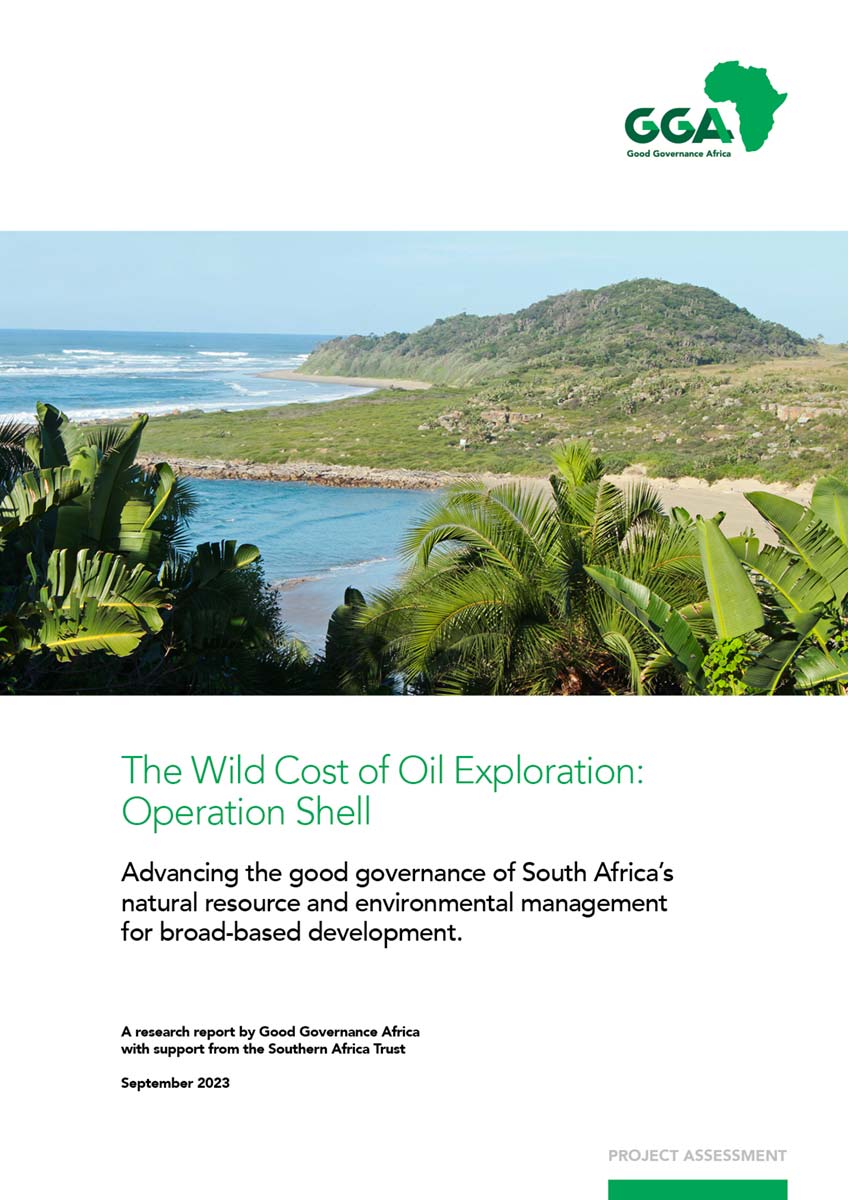
Recent significant oil and gas discoveries seen in the Karoo Basin and the Wild Coast of South Africa have sparked a national debate that raised questions about climate change mitigation and adaptation, and the potential negative impact on local ecologies and communities. Specifically, oil exploration off the Wild Coast, using seismic blasting tests by Shell South Africa, a multinational energy company, in October 2021 highlighted critical governance issues related to natural resource and environmental management, as well as whether meaningful consultation processes with affected communities had taken place. Through pressure from interested and affected parties, the Makanda High Court in Gauteng province granted an interdict against the proposed seismic blasting by Shell. The research presented in this report included fieldwork studies among interested and affected communities in the Wild Coast, key informant interviews, as well as a review of relevant documentation
and legislation.
Our preliminary research findings show shortcomings in legislation governing the environmental management of mining, particularly discrepancies within the Mineral and Petroleum Resources Development Act, 2002 (MPRDA) and the National Environmental Management Act (NEMA), 1998, and their subsequent amendments. The seismic survey was legally disputed on the basis that it did not obtain environmental authorisation in terms of NEMA. Second, it revealed the inadequate consultation process with interested and affected parties. In closing, relevant governing departments need to better align and streamline regulatory frameworks that administer the implementation of mining application approvals and management of environmental authorisations. This requires department personnel to have an in-depth knowledge of the legislation and be strongly capacitated to administer relevant regulations accurately and consistently. Multinational corporations need to improve their consultation process mechanisms and gain a better understanding of the environmental context and affected communities. At the centre of improving South Africa’s socio-economic conditions, is the political will to strengthen good governance, transparency, and accountability mechanisms.

Busisipho Siyobiis a public policy researcher with a focus on the intersection of mineral resource governance and climate change in Southern Africa. Her research focuses on advancing the integration of Environmental, Social, and Governance (ESG) factors and social performance within the extractive industries and shaping climate change response strategies that foster sustainability. She leads a programme team in developing and executing the research strategy on mineral resource governance and climate change. She works closely with civil society, industry, and international organisations in this capacity to promote good governance, transparency, and accountability to enable sustainable investment and development. Busisipho holds a Master of Philosophy in Public Policy from the University of Cape Town.