Across Nigeria, a quiet but profound crisis is unfolding, draining potential, eroding discipline and jeopardising the future of an entire generation. For decades, young Nigerians have struggled against unemployment, underemployment, insecurity and a fragile education system. In the absence of stable opportunities, many have improvised survival strategies. Today, however, a new “solution”, gambling, has taken centre stage, presenting itself as legal, accessible and deceptively empowering.
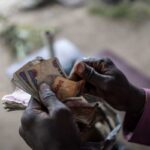
For instance, sports betting has become normalised as an economic coping mechanism in a country where legitimate pathways to prosperity remain painfully narrow. What was once a casual weekend pastime has evolved into a daily ritual in university hostels, roadside kiosks, transport parks, shops and even outside places of worship.
The scale of the industry’s expansion is staggering, as betting revenues have crossed the billion-dollar mark, with Lagos contributing a significant share annually. According to the Securities and Exchange Commission (SEC), over 60 million Nigerians gamble daily, spending about $5.5 million. On average, these bettors spend around ₦3,000 daily, fuelling a rapidly growing market driven by widespread mobile phone adoption and economic pressures.
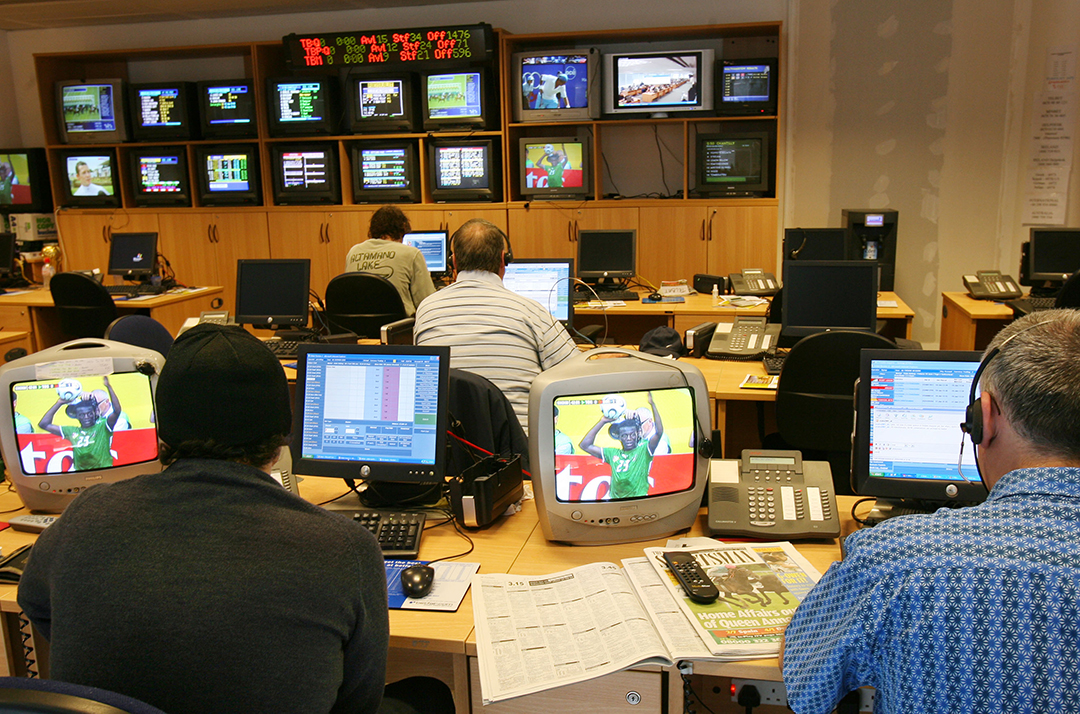
Telephone betting operators monitor the World Cup Switzerland vs Togo match on television monitors, 2016. Photo by Suzanne Plunkett/Bloomberg via Getty Images)
Psychological vulnerability
Beyond the impressive figures lies a more troubling reality, as the industry thrives by tapping into the psychological vulnerability of youths. From various interviews with youths on betting, many do not see risk. They see opportunities, particularly because many betting sites are endorsed by celebrities who sell the idea of instant transformation. No qualifications required, no capital investment, no networks, just prediction.
For us at Good Governance Africa (GGA), this is not innovation; it is speculation. It is not entrepreneurship; it is engineered probability. For every highly publicised “big win” circulating on social media, there are thousands of quiet losses, such as unseen debts, anxiety, depression and financial instability. The culture of false hope keeps many trapped in a cycle where yesterday’s loss is justified by tomorrow’s imagined victory.
It would make more sense to see time spent studying as odds invested in digital skills, vocational training, or civic engagement. Money lost on betting tickets is capital that could have supported micro-enterprises, online certifications or savings.
Governance failure
This crisis cannot be reduced to individual moral weakness. It is fundamentally structural. Gambling thrives where economic opportunity is scarce, regulatory oversight is weak and public institutions fail to offer credible alternatives.
Nigeria’s regulatory frameworks have struggled to keep pace with the rapid expansion of online betting platforms. Consumer protection mechanisms remain limited. Public awareness campaigns are weak. Meanwhile, advertising continues to target young people who are the most economically active demographic.
When young people turn to betting as a survival strategy, it signals a breakdown in the social contract. It reveals a generation that feels excluded from formal economic participation and disconnected from meaningful democratic engagement. Addressing the gambling surge requires a multidimensional response, including strengthened regulation of betting advertising and digital platforms; transparent consumer protection standards; robust public education campaigns; expanded youth employment and entrepreneurship opportunities; and the integration of mental health services into primary healthcare systems.
From false hope to civic empowerment
Sustainable change demands that young Nigerians are empowered not only economically but also civically. This is where initiatives such as GGA’s Youth Advocates for Good Governance (YAGG) become critical. YAGG equips young Nigerians with leadership development skills, civic education, policy advocacy training and structured platforms for engagement with decision-makers. Rather than leaving young people to gamble on chance, it enables them to influence systems.
Through leadership training and civic literacy, young participants learn how budgets are allocated, how policies are formulated and how accountability mechanisms function. Through advocacy capacity-building, they gain the tools to demand reforms that expand economic inclusion. Through engagement platforms, they interact directly with policymakers, transforming frustration into constructive participation.
When young people are empowered to shape governance outcomes, the appeal of speculative escape weakens. Real opportunity begins to replace artificial hope.
Reclaiming Nigeria’s future
Betting is not merely a social trend; it is a signal of economic exclusion, weak regulation and generational anxiety. If ignored, the costs will extend beyond individual financial losses to broader civic and developmental consequences.
Nigeria faces a clear choice. We can continue to jeopardise our future by chance, or we can invest deliberately in governance reforms and youth empowerment that restore dignity, discipline and possibility. Reclaiming the future demands bold, collective and immediate action, building an economy where work is rewarded, strengthening institutions that protect the vulnerable and creating civic platforms where young people are not spectators but active shapers of national progress.
Through sustained governance reform and initiatives like YAGG, young Nigerians will move from the illusion of quick wins to the reality of long-term transformation.

Kabir Hassan is a researcher at Good Governance Africa-Nigeria. He holds a Bachelor of Science in Transport Planning and Policy from Lagos State University, Nigeria. His research focuses on sustainable transport development and planning, with a strong interest in policies that promote equitable and efficient mobility systems. Kabir is actively involved in community development work, especially youth capacity-building initiatives and youth civic engagements. He has been part of notable transport-related projects through his roles at the Lagos Metropolitan Area Transport Authority (LAMATA) and TSL Metroline Limited, where he was involved in road transport network operations and survey analysis.