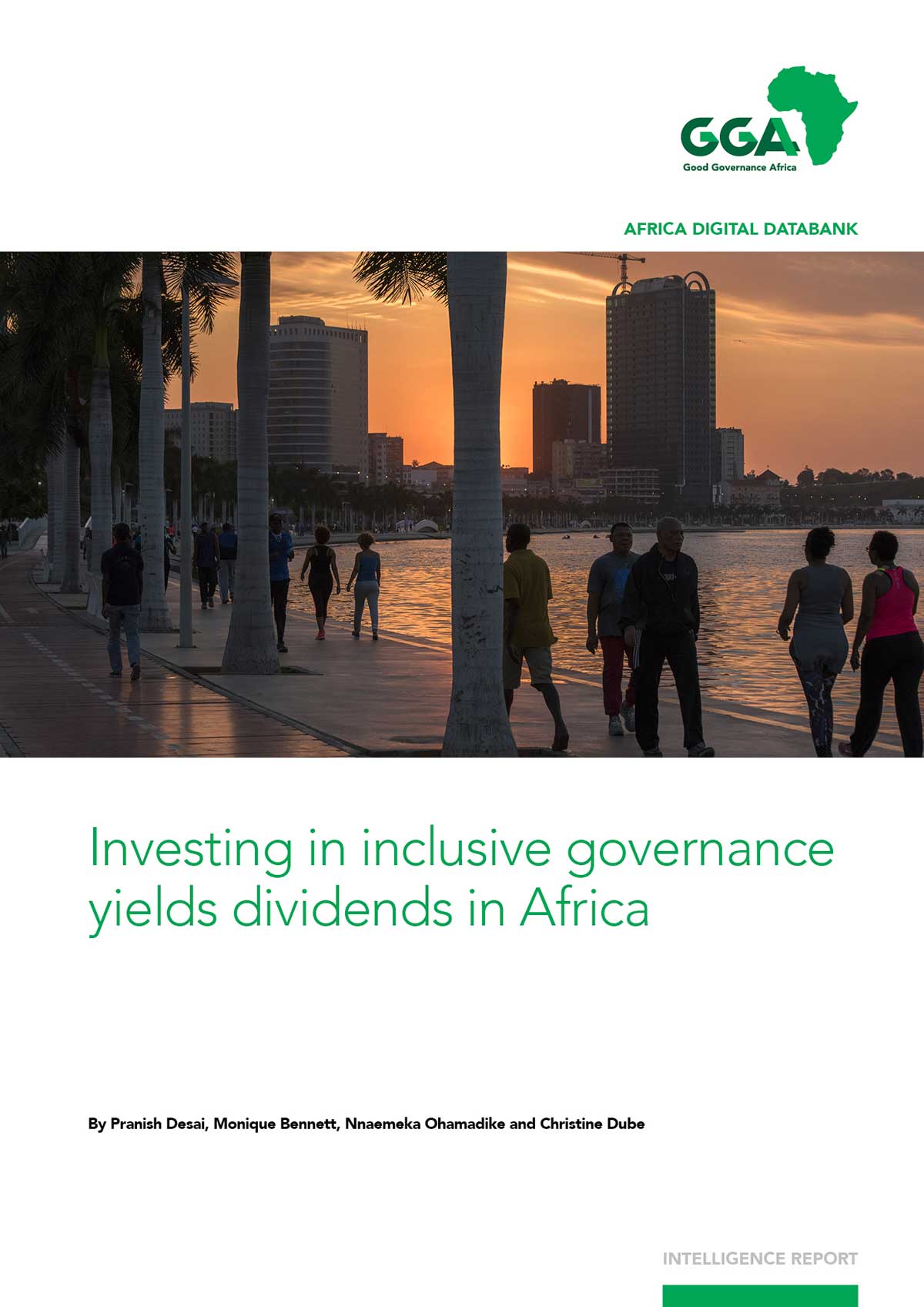
Over the long term, there is a clear association between accountable and inclusive governance on the one hand and broad-based economic development on the other.
We find empirical support for this assessment at the global, African, and regional levels within Africa across both shorter and more extended periods of time. The explanation is that a long-term governance environment which embraces accountability is also more politically stable, enabling consistent policymaking, which can sustain economic dynamism and meet citizens’ needs. Concerningly, there are African countries, including Angola, which have recently sought to repress rather than encourage participation. This has been one contributing factor to the recent stagnation and reversals which Angola has experienced in critical measures of human development pertaining to education, health and economic outcomes. This intelligence report identifies the critical implications that this finding has for companies with committed financial interests in African countries:
- The importance of inclusive governance is that a more participatory, accountable and non-discriminatory society will also see corresponding improvements in broad-based economic development, which benefits businesses and citizens in tandem.
- The private sector has both an incentive and a responsibility to actively invest in mechanisms that encourage accountable governance in African countries where they operate.
- Investing in these mechanisms minimises the reputational risk companies open themselves up to by engaging in opportunistic behaviour which bolsters rather than blocks repressive behaviour by African governments.
- Through supporting inclusive governance initiatives emanating from African civil society and local communities, companies can demonstrate that they have a long-term commitment to fostering economic development in the world’s fastest-growing continent.

Pranish Desai is a doctoral student in political science at the Massachusetts Institute of Technology. His core areas of focus are in comparative politics and political methodology, with a specific interest in the politics of Southern Africa. Between 2021 and 2024, Pranish held several key positions within the Governance Insights and Analytics programme at GGA. In these roles, he was centrally responsible for the elevation and enhancement of the Governance Performance Index as GGA's flagship governance assessment tool. Before departing GGA, Pranish also played a key role in the development of our strategic framework for the 2024-2028 period.

Monique Bennett holds a Master’s degree in International Relations from the University of the Witwatersrand. She is currently pursuing her Doctorate in Political Science at Stellenbosch University funded by the Peace Research Institute of Oslo. She enjoys a mixed-methods approach to research across topics such as governance, environmental issues, human security and peacebuilding within the African context. She supports her research team by providing data-driven evidence for their research/op-eds and writes for various South Africa news outlets.

Nnaemeka served as a Senior Data Analyst at Good Governance Africa. He completed his PhD in Applied Data Science at the University of Johannesburg, South Africa, supported by South Africa’s Department of Science, Technology and Innovation. His research applies data science and computational methods to questions of governance, social bias, political attitudes, human development, and disinformation. His work has been published in journals including EPJ Data Science, Journal of Computational Social Science, Social Science Computer Review, Political Psychology, and Politeia. He has also worked as a Data Consultant at DataEQ Consulting and has teaching experience at the University of the Witwatersrand, both in South Africa.

Chrissy Dube is an executive at Good Governance Africa (GGA) and a member of the Business Ethics Network (BEN) — Africa Networking Council. An advanced project manager with deep implementation, monitoring and evaluation expertise, she also specialises in strengthening stakeholder relations to drive business development. She uses her skills and expertise to provide innovative solutions and recommendations for sustainable development across the public and private sectors.
Chrissy combines rigorous data-led analysis with strategic insight to design practical, evidence-based solutions and policy recommendations that enable informed decision-making. Her core strengths include advocacy, business risk management, stakeholder collaboration and strategic alignment as an implementing partner — consistently enabling organisations to translate strategy into measurable results.
She holds an MA (Commerce) from the University of KwaZulu-Natal and has completed professional qualifications in Data Analysis, Advanced Project Management and Advanced Risk Management at the University of Cape Town. She is also certified as an Ethics Officer for the private and public sectors through Stellenbosch University.